Flag of Mexico
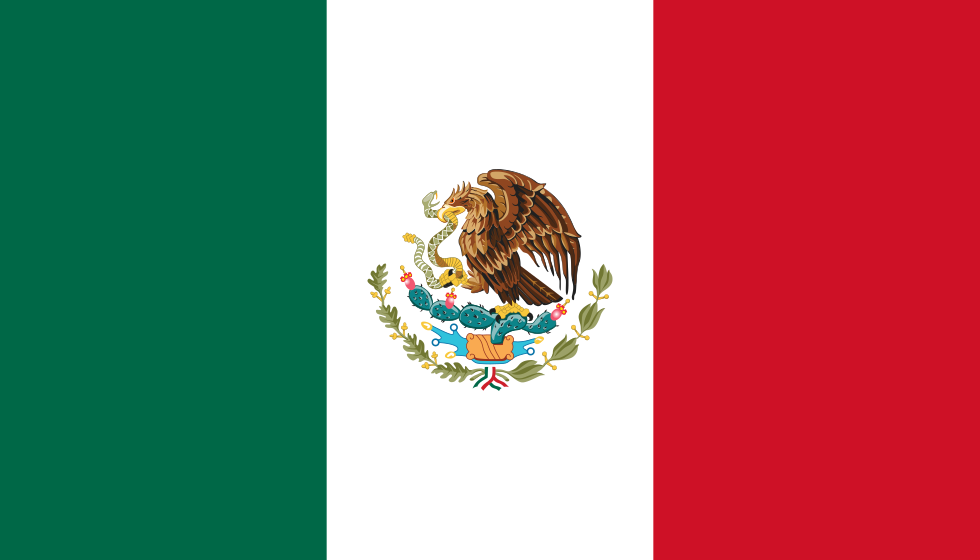
What the flag means
- Green — hope and independence
- White — unity and purity
- Red — the blood of national heroes
- Eagle and snake on a cactus — the Aztec legend of founding Tenochtitlan
Design set by: Ley sobre el Escudo, la Bandera y el Himno Nacionales (DOF 08-02-1984), Artículo 3 · Adopted 1968
Highlights
- 🌮 Tacos and world-class food
- 🏛️ Ancient Maya and Aztec ruins
- 🎉 The colorful Day of the Dead
- 🏖️ Cancún and Caribbean resorts
- 🎺 The joy of mariachi music
Quick facts
- Region
- Americas · North America
- Population
- 131,946,900 people (2025)
- Area
- 1,964,375 km²
- Capital
- Mexico City
- Languages
- Spanish
- Currency
- Mexican peso (MXN)
- Organizations
- United Nations, OECD
Similar flags
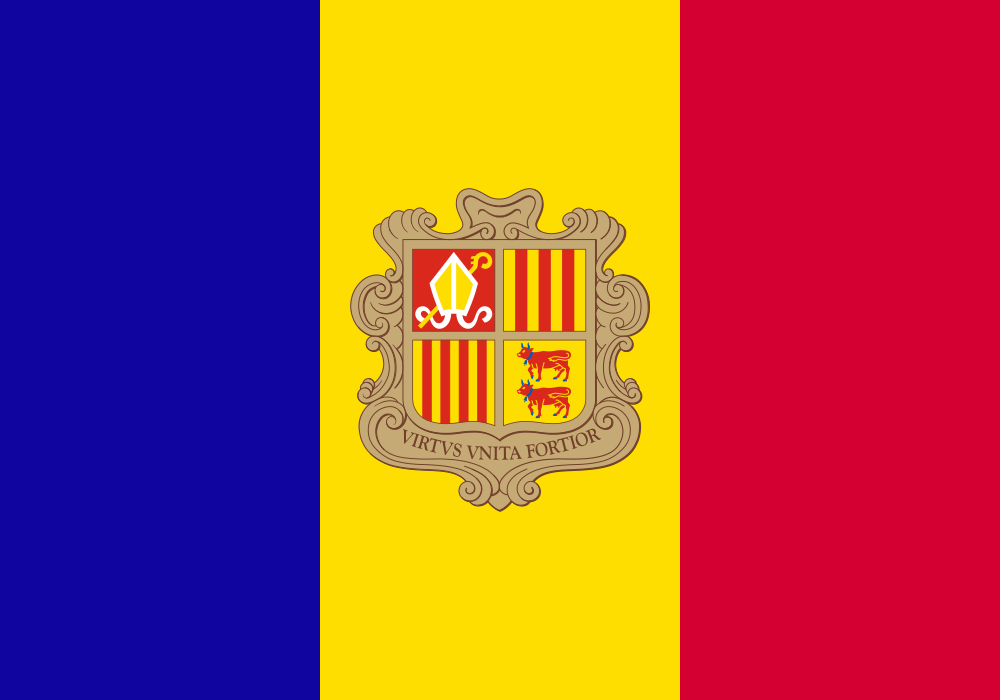
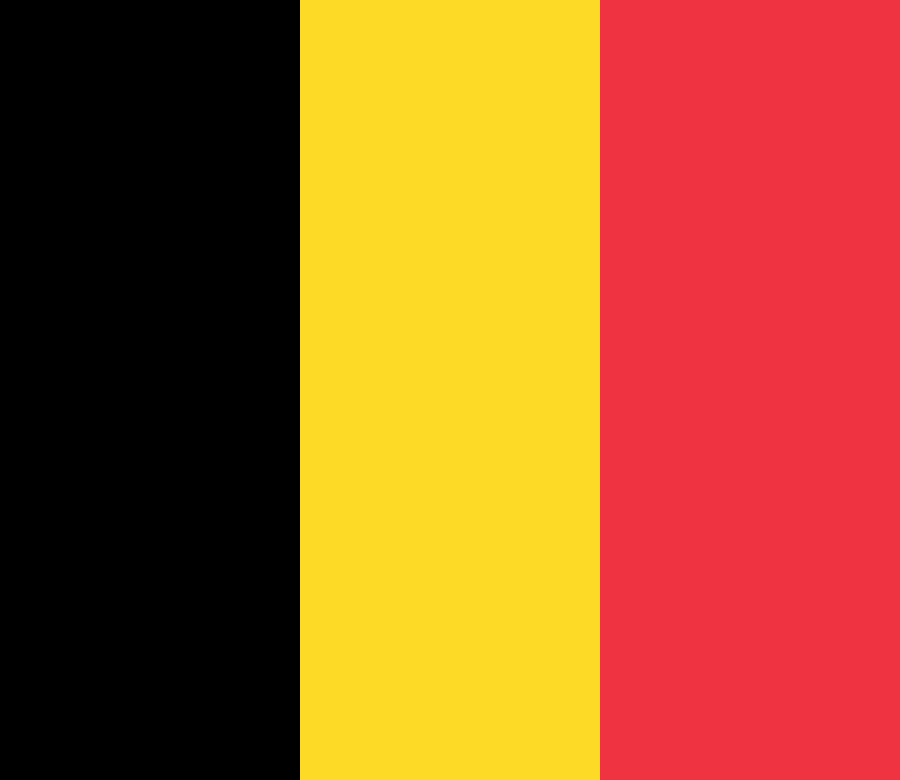
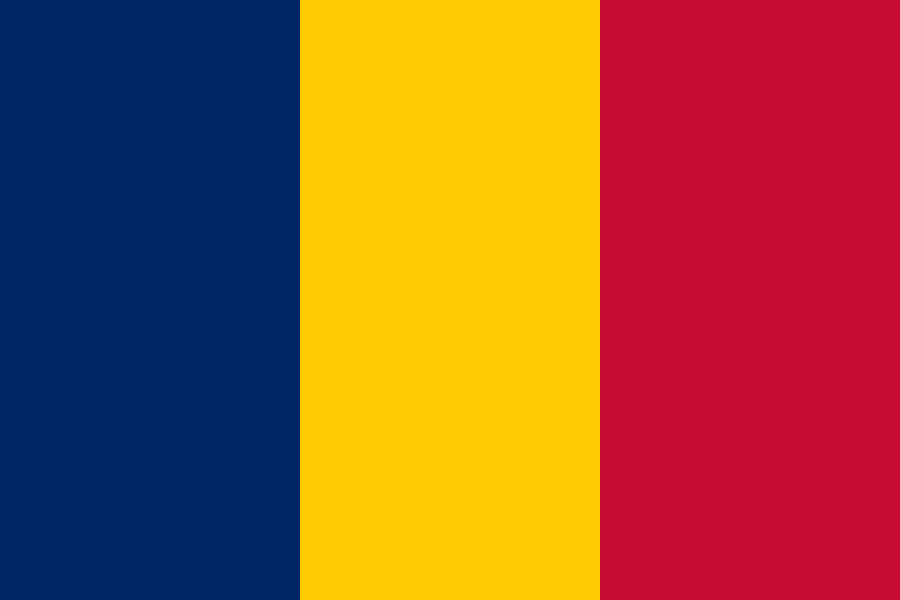
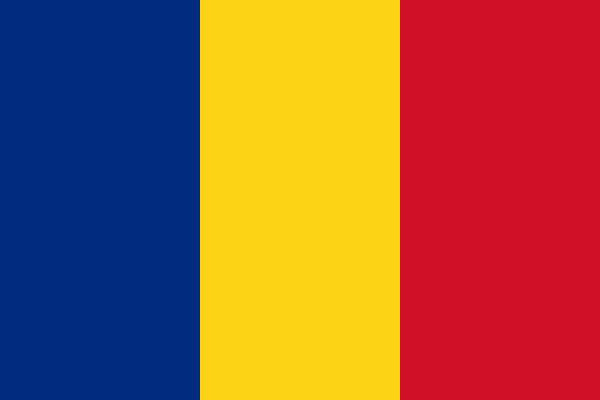
Vertical tricolors

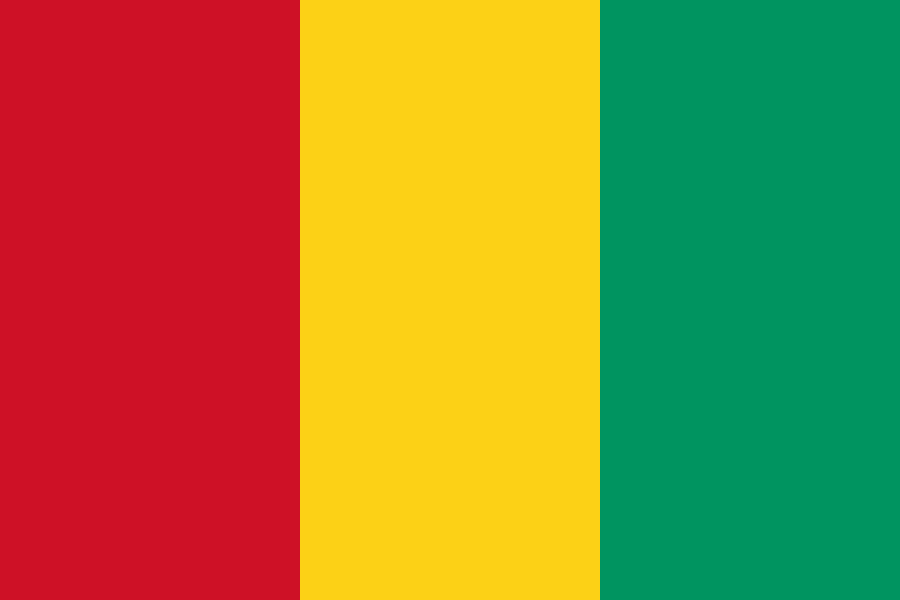



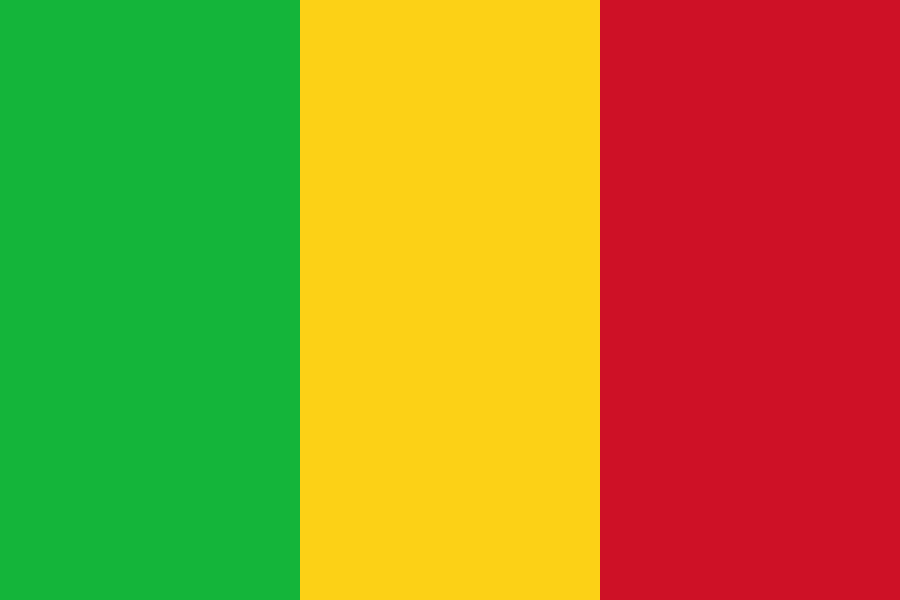
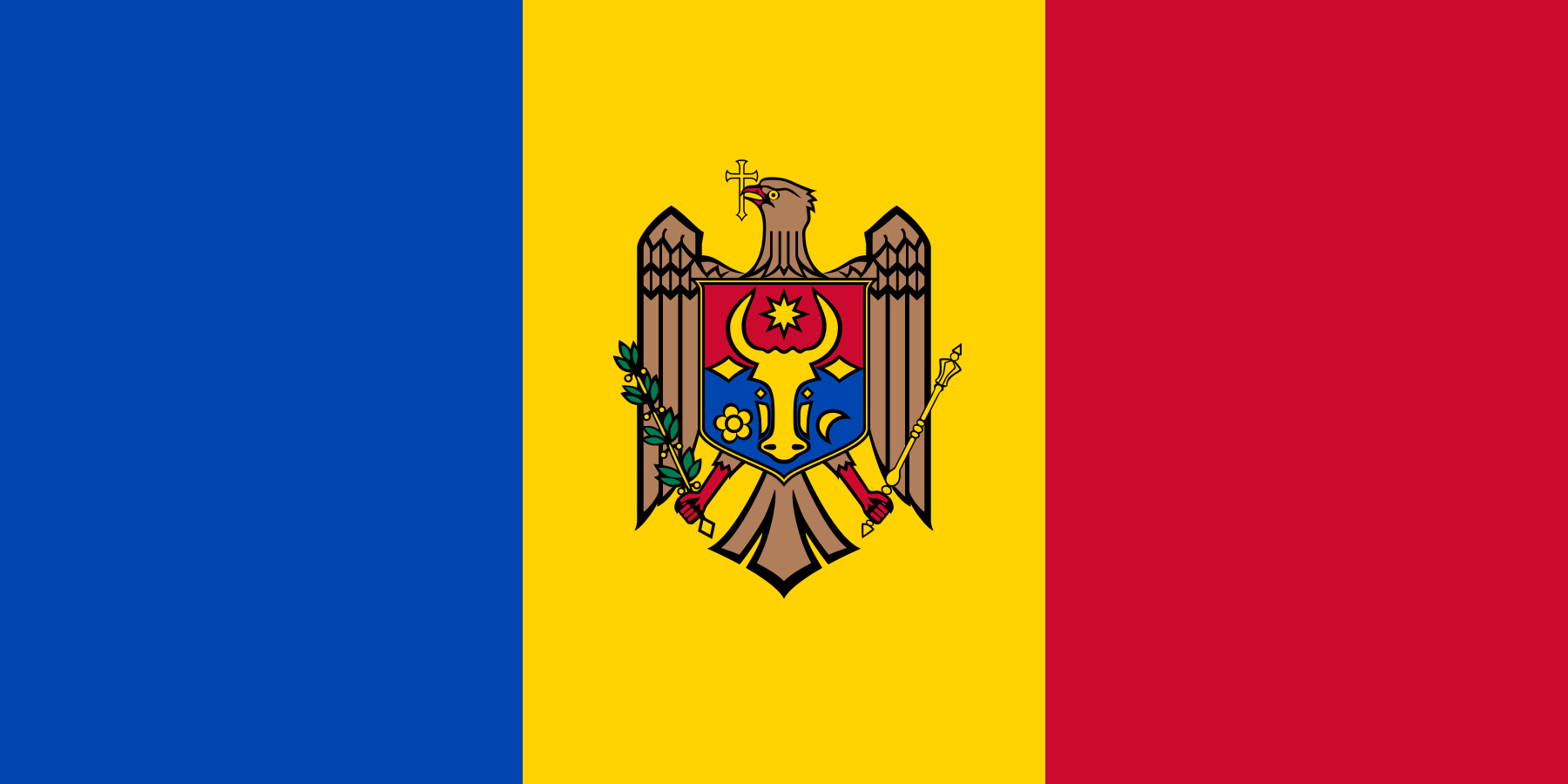
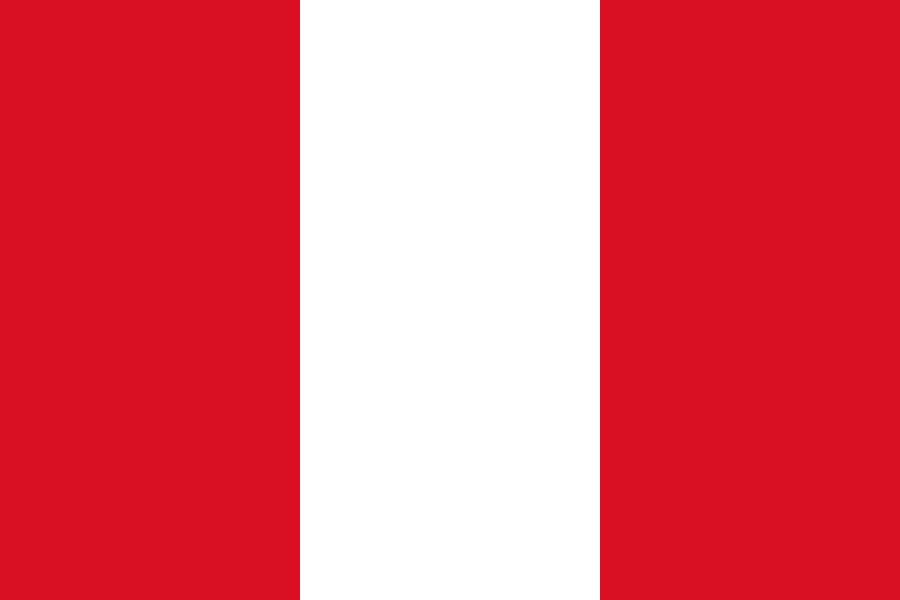
Neighboring countries
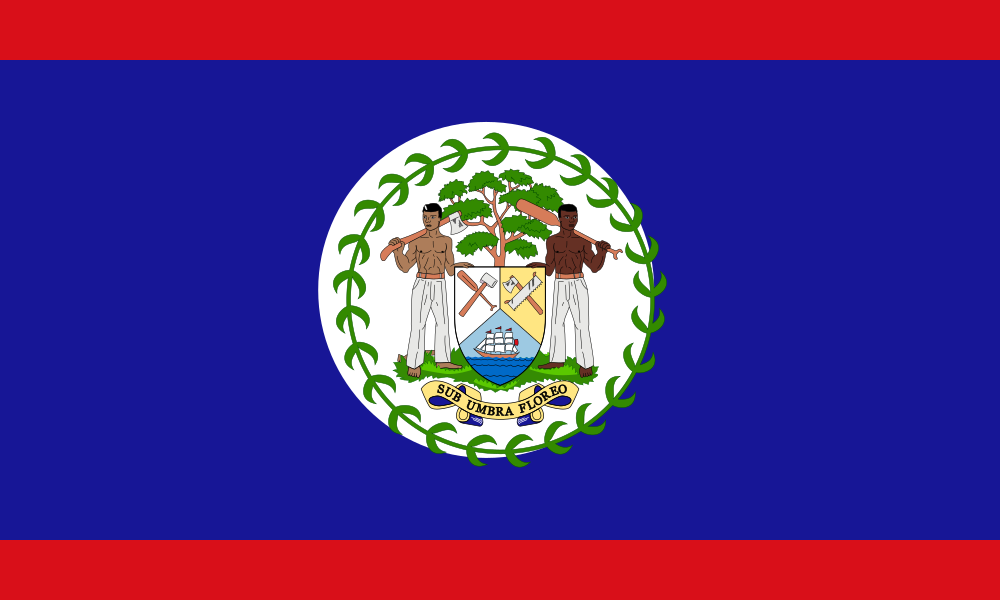
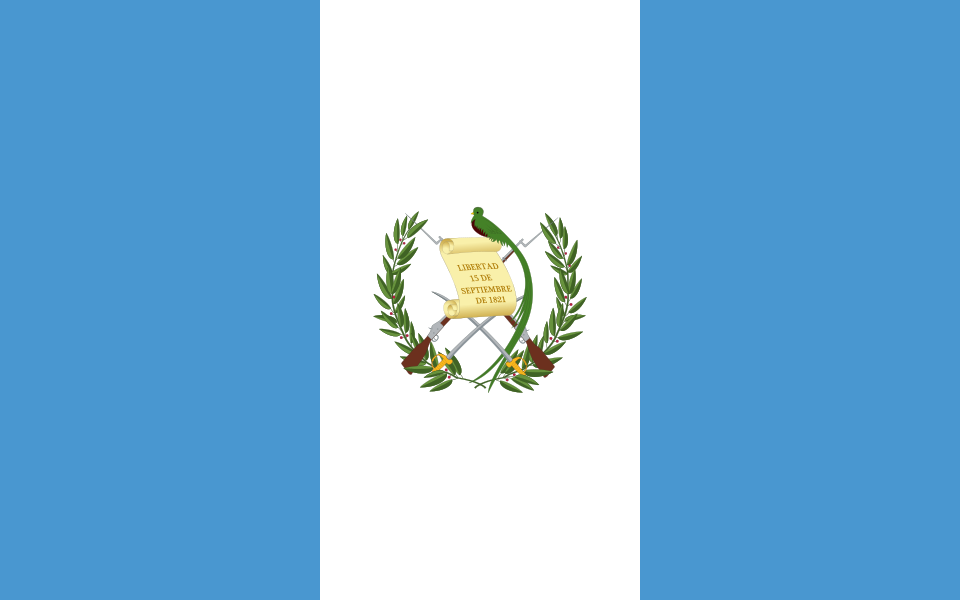
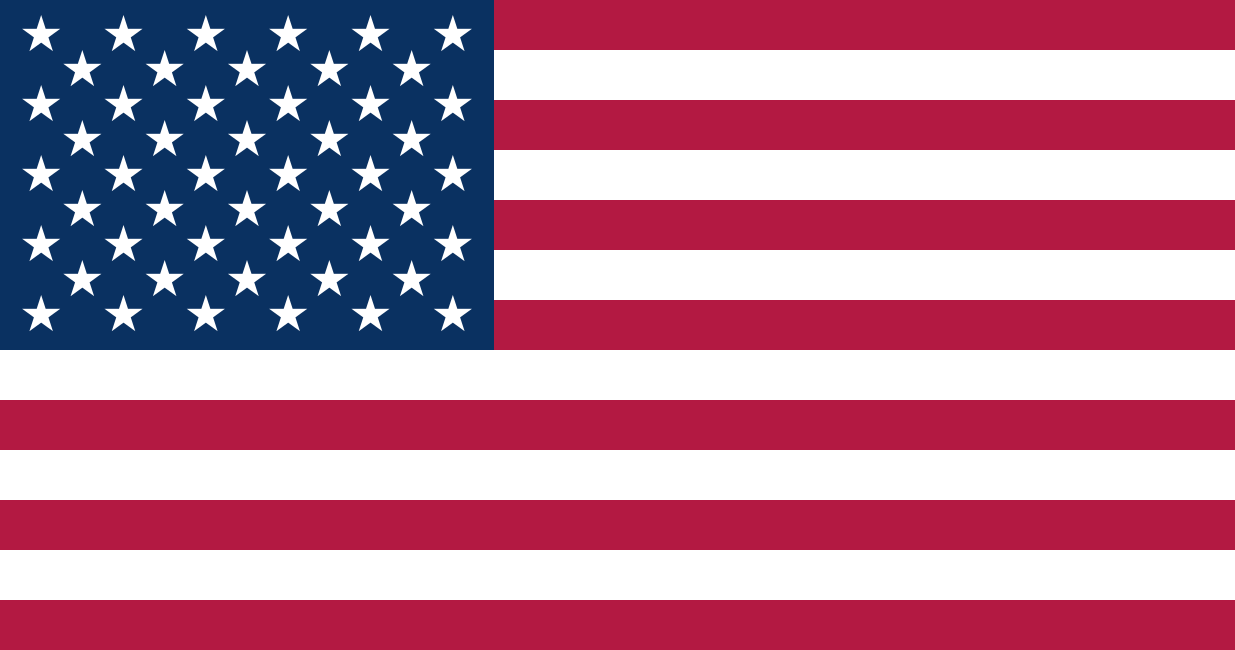
Land neighbors, approximated from simplified map outlines.
Symbols in History (4)
Coats of arms and emblems whose historic seat lies within this country’s present-day territory.
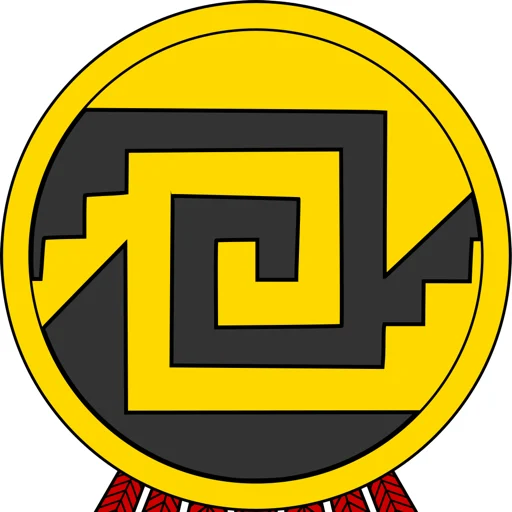
Aztec Warrior Shield (Chimalli)
OriginChimalli is the Nahuatl word for the round shield carried by Mexica (Aztec) warriors on the highlands of central Mexico before the Spanish conquest. The finest were built on a frame of cane and wood, faced with a mosaic of tropical feathers, and finished with a fringe of feathers hanging from the lower edge. The drawing shown here is a modern rendering of that type of shield, decorated with the stepped-fret motif called xicalcoliuhqui, rather than a copy of any single surviving piece.
DescriptionApart from the thick golden-yellow ring that frames the disc, only two colours fill it, gold and charcoal, in almost equal share. Each colour draws the same figure: a squared spiral coiled at the centre, a flight of right-angled steps running off to one side, and a long forty-five-degree edge slicing away a triangular wedge. The two figures interlock as exact half-turns of one another, so neither can be called the ground. This union of spiral and staircase is the xicalcoliuhqui, one of the most widespread designs in Mesoamerica, found on palace walls and in woven cloth alike. On a real shield the pattern would have been filled in with glued feathers, and the red feathers hanging below the rim are the fringe that finished such shields.
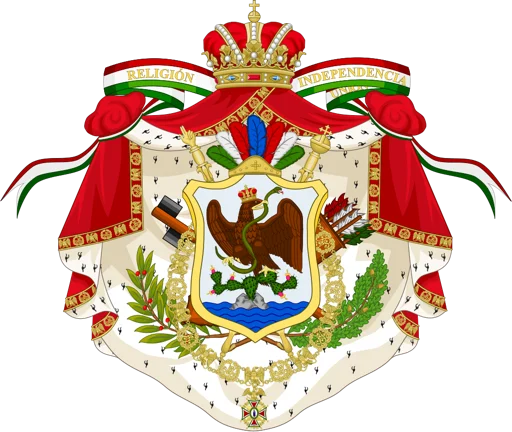
Coat of Arms of the First Mexican Empire
OriginMexico broke away from Spain in 1821, and the following year Agustin de Iturbide was crowned emperor. These arms belonged to that empire, which lasted only from 1822 to 1823. The core of the design is the Aztec legend of the founding of Tenochtitlan, dressed in European imperial regalia; the picture shown here is a modern redrawing of that design.
DescriptionOn a silvery-white shield a brown eagle stands with wings spread, a green serpent in its beak and a small gold crown on its head, perched on a pink-flowering nopal cactus that grows from a rock in blue water — the spot where the Mexica were said to have founded their capital. Above the shield rises a plume of green, white, red and blue feathers, flanked by a sceptre topped with the hand of justice and another topped with a cross-bearing orb, the whole covered by a gold imperial crown and a red mantle lined with ermine. A laurel branch with red berries and an oak branch with acorns frame the shield; behind it cross a wooden war club edged with dark stone blades and a quiver of arrows fletched in green, white and red, while the gold collar around the shield ends in the badge of the Order of Guadalupe with the Virgin at its centre. The tricolour scroll at the top reads RELIGIÓN, INDEPENDENCIA, UNIÓN — the three guarantees of the Plan of Iguala that carried the country to independence.
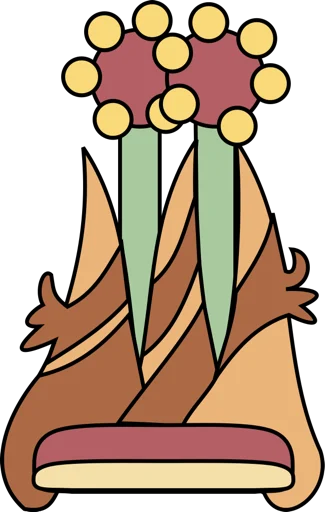
Tetzcoco Altepetl Glyph
OriginNahua city-states, called altepetl, wrote their names as pictures rather than in letters, and that picture also served as the town's mark. Tetzcoco, the Acolhua capital on the eastern shore of Lake Texcoco, joined Tenochtitlan and Tlacopan in the Triple Alliance of 1428 and was renowned for its law and learning until the Spanish conquest of 1521. The drawing shown here is a modern vector rendering of the glyph as it survives in colonial-era manuscripts.
DescriptionThe lower two thirds is the standard Nahua sign for a hill: a bell-shaped mound worked in alternating bands of ochre and warm reddish brown, with a lobed spur curling out at each flank and, along the foot, a dusty red stripe laid over a cream one, below which the base splays into two small feet. Two broad pale-green blades run up the face of the mound and out past its crest, each carrying a round head of muted rose ringed with golden discs. The hill marks the picture as a place name, and the plant growing out of it gives the clue to which place it is.
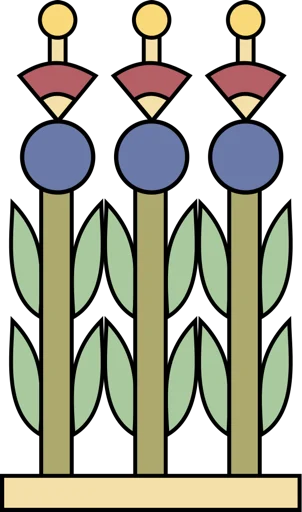
Tlacopan Glyph
OriginTlacopan was a Tepanec city-state on the western shore of Lake Texcoco. In 1428 it joined Tenochtitlan and Texcoco in the Triple Alliance and stayed in it as the smallest of the three partners until the Spanish conquest of 1521. Nahua scribes wrote place names as pictures, and Tlacopan combines tlacotl, a stem or switch, with the locative ending -pan, so the name was written with that plant. The drawing shown here is a modern vector version of the sign rather than a page from an old manuscript.
DescriptionA pale cream band runs across the bottom of the image like a strip of ground, and three olive stalks rise from it side by side. Each stalk carries pointed light-green leaves in two tiers, one to the left and one to the right. All three tops are built the same way: a large blue-violet disc, above it a red fan opening upward whose narrow lower point is cream rather than red and tapers down toward the disc, and at the very top a slender shaft capped by a yellow ball. The plant itself is the name, and the band beneath it marks the ground the name grows out of.


State & regional flags (32)
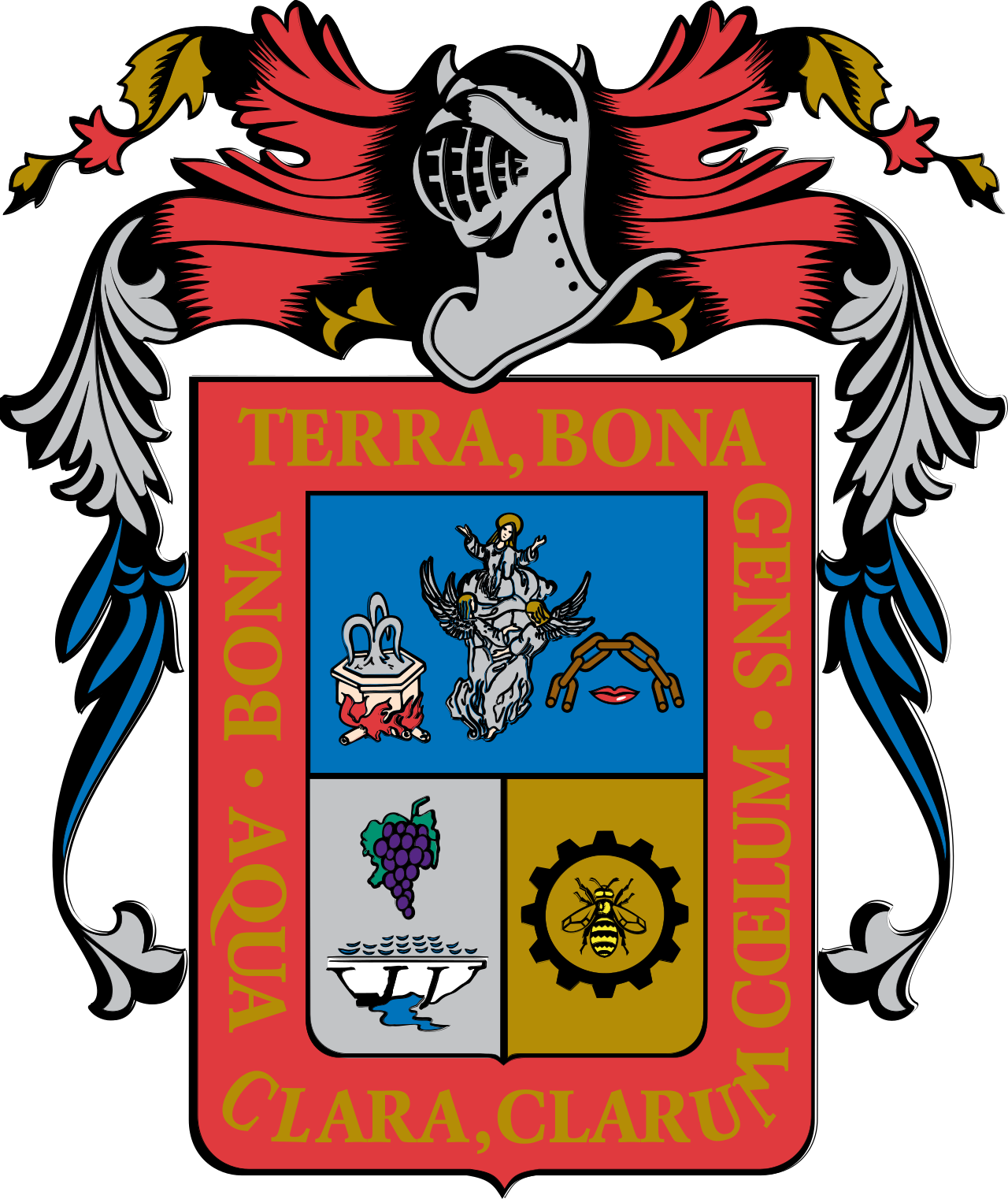
Aguascalientes
At the centre of the upper quarter two angels bear the Virgin of the Assumption aloft, with a spring over flame to her left and a broken chain to her right. The lower silver quarter holds grapes and a dam with water spilling over it, and the lower gold quarter a bee within a cogwheel. The broken chain stands for freedom, the spring for the hot springs that gave the state its name.
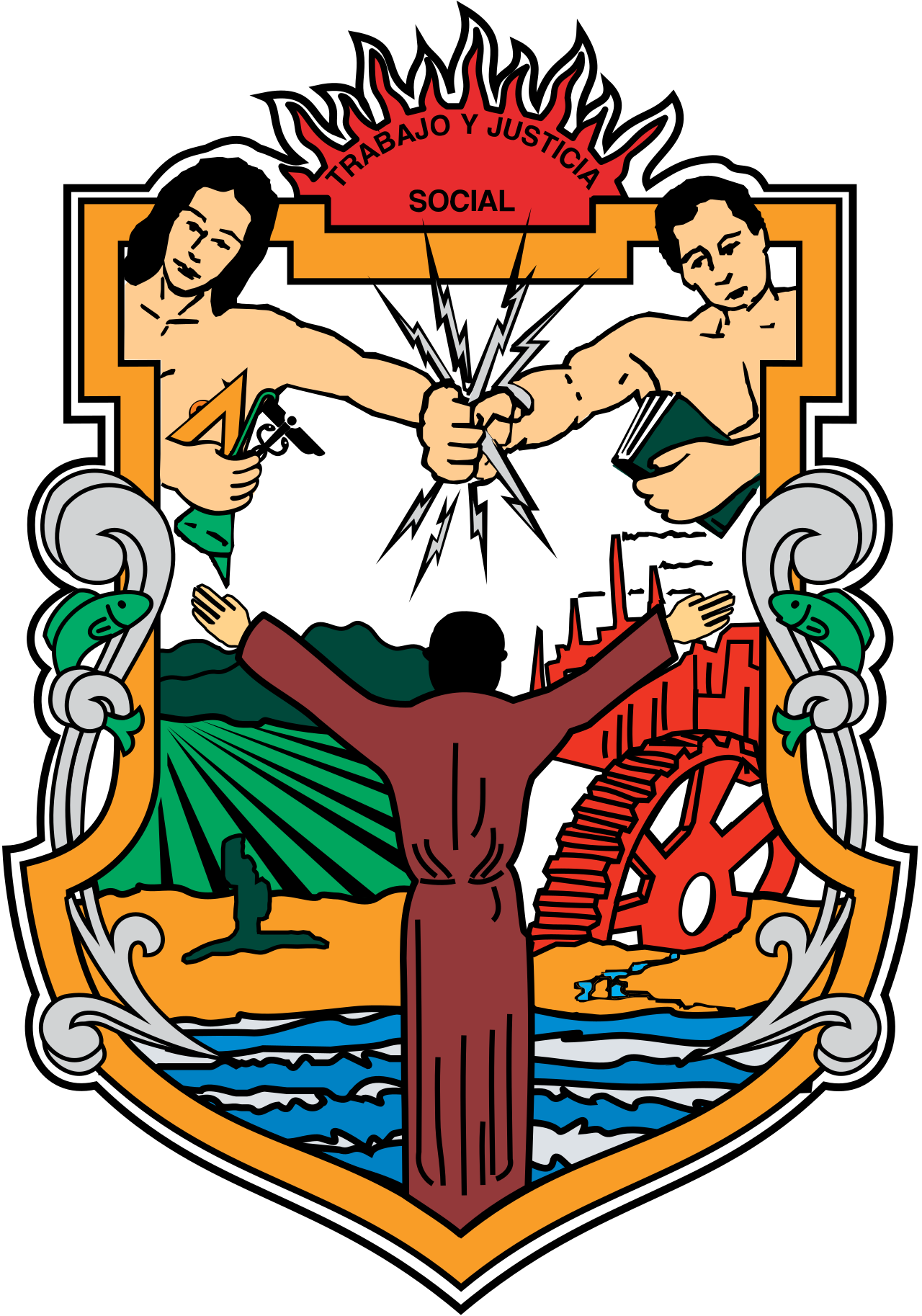
Baja California
A figure with both arms flung wide stands the full height of the shield, framed by green fields to the left, a red cogwheel to the right and a blue sea below — the people of this land, with its farming, industry and coast.
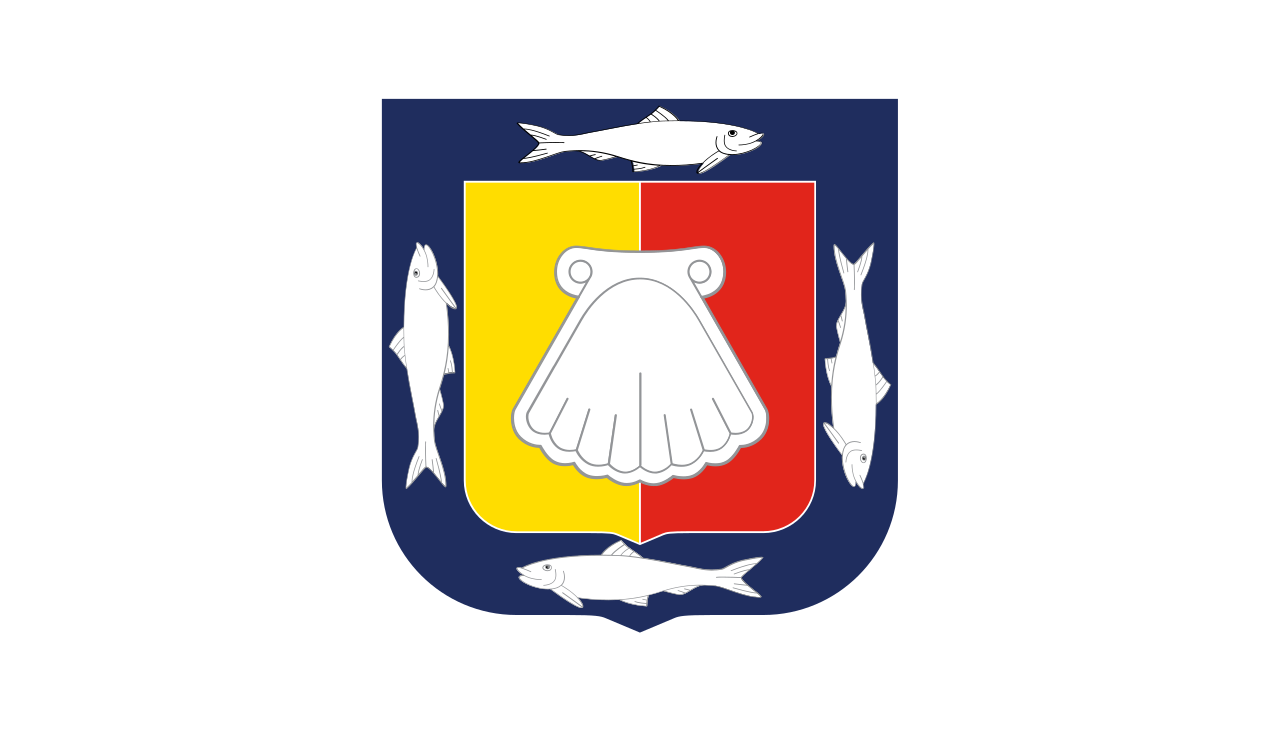
Baja California Sur
White, charged with a navy shield: four silver fish swim around a smaller shield split gold and red that carries a large white scallop.
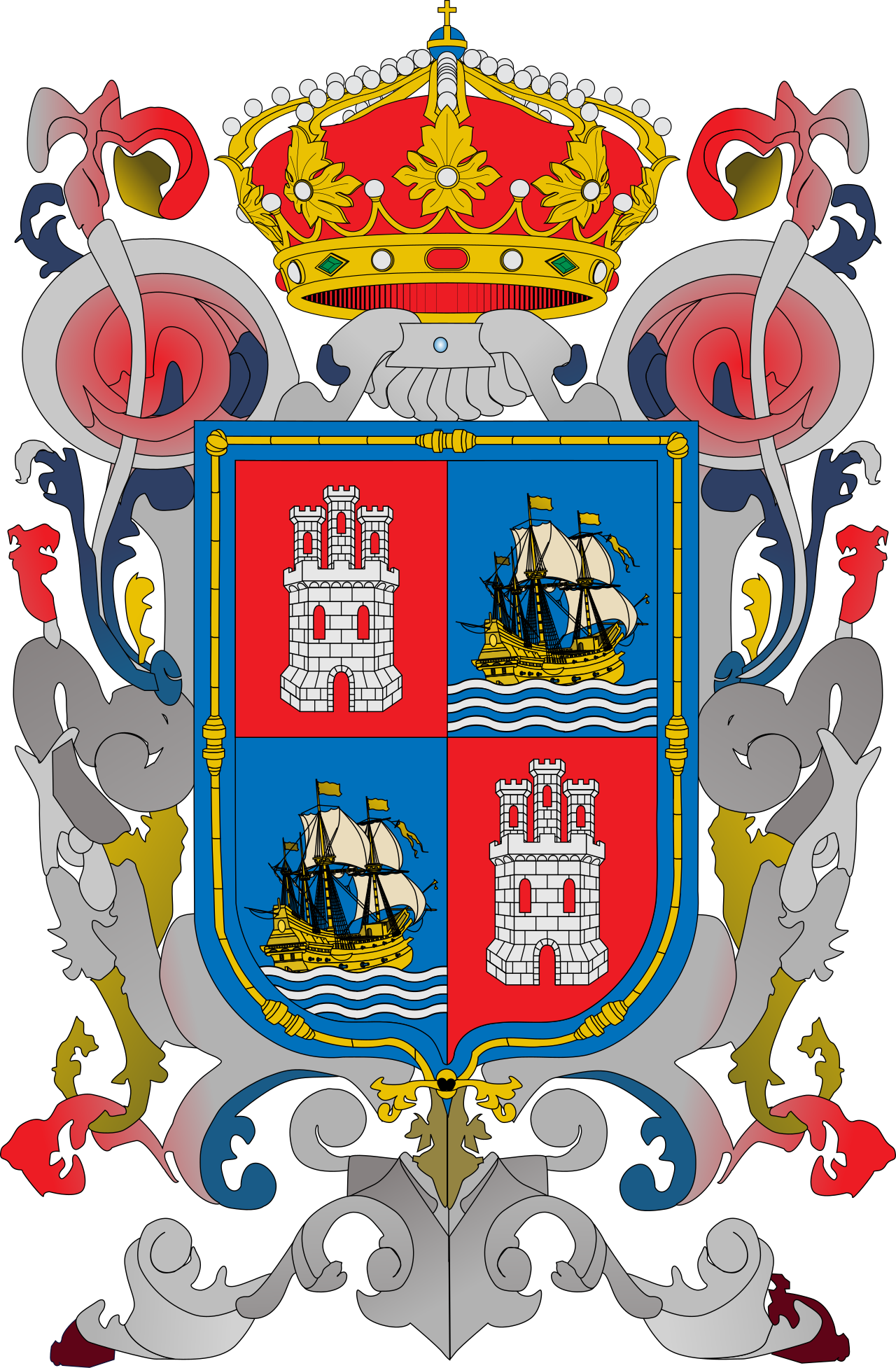
Campeche
Quartered arms beneath a pearled crown: two silver three-towered castles on red alternate with two golden galleons under sail on white waves.
Chiapas
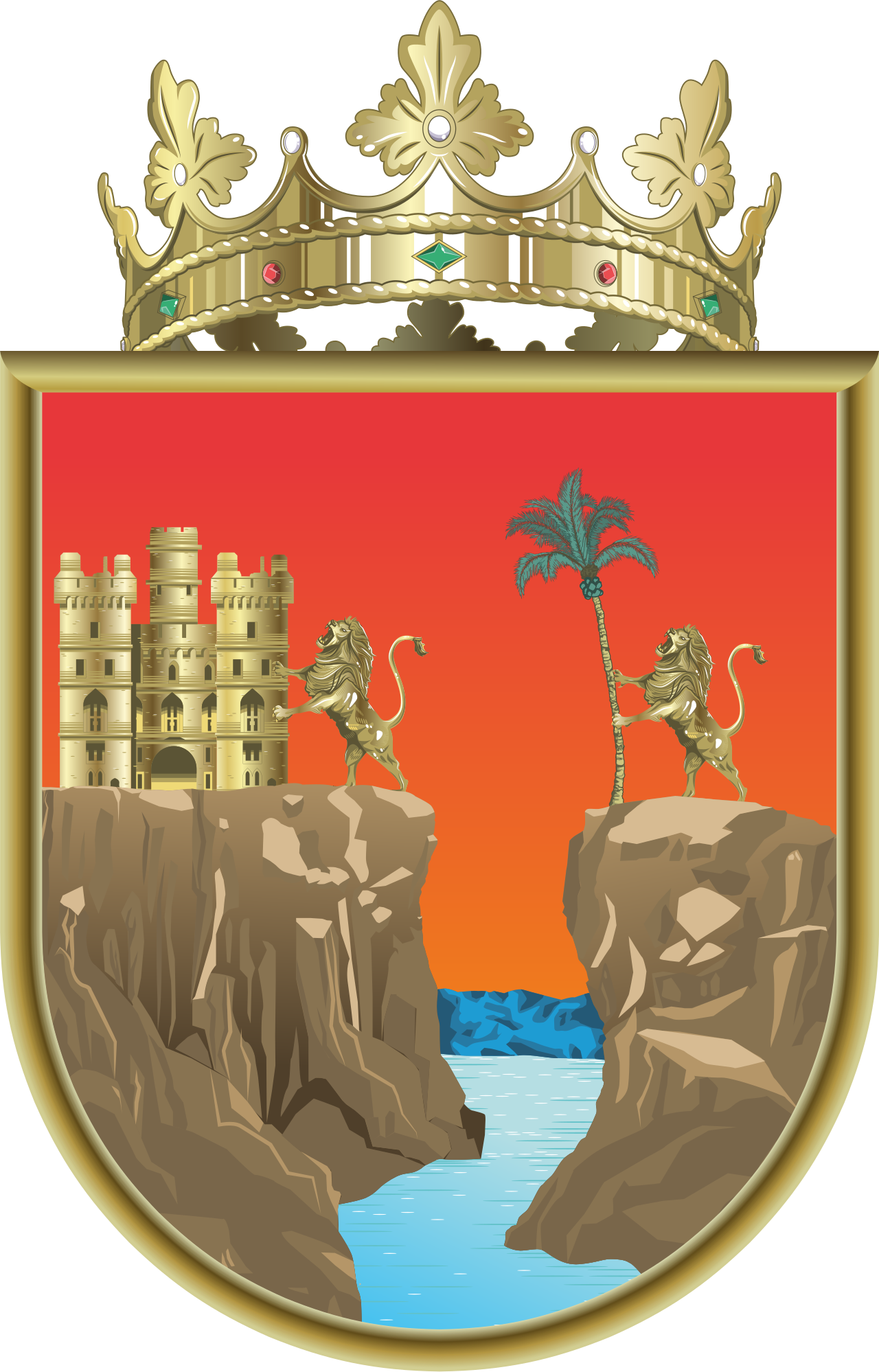
Between two cliffs split by a river stand two golden lions, one by a castle and one holding a palm, under a crown against a red-orange sky.
Chihuahua
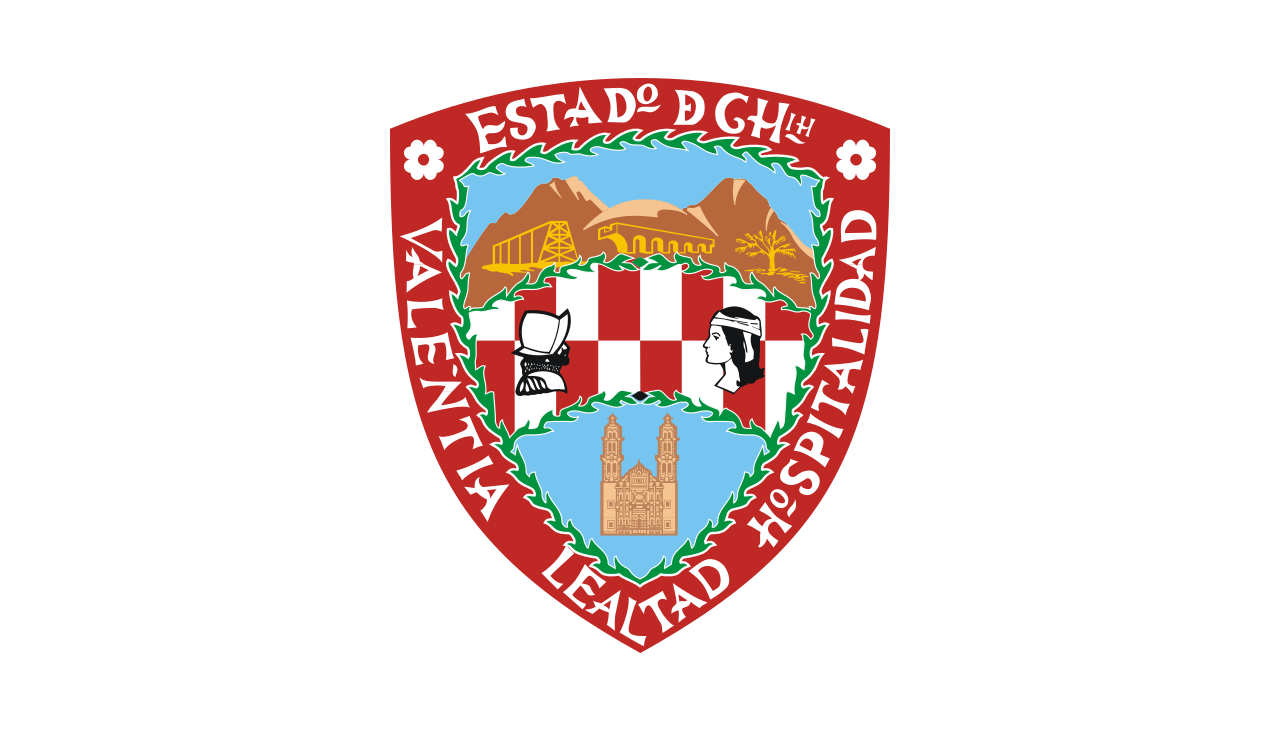
A green laurel wreath encloses brown sierras with a mine headframe, a conquistador helmet facing an indigenous profile, and a twin-towered cathedral.
Coahuila
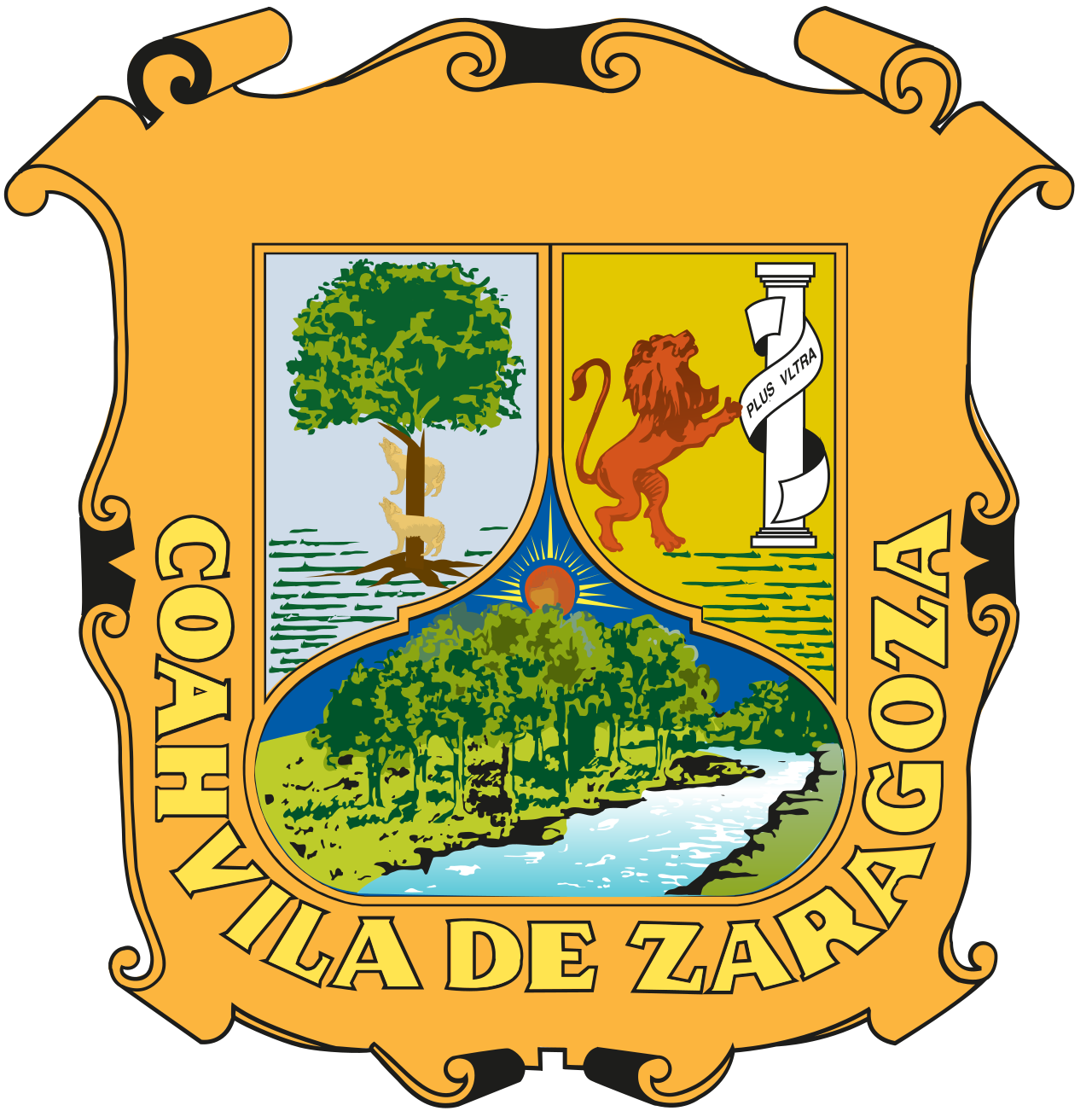
A gold cartouche lettered Coahuila de Zaragoza holds three scenes: wolves at a leafy tree, a red lion by a Plus Ultra column, and a sun rising over wooded banks.
Colima
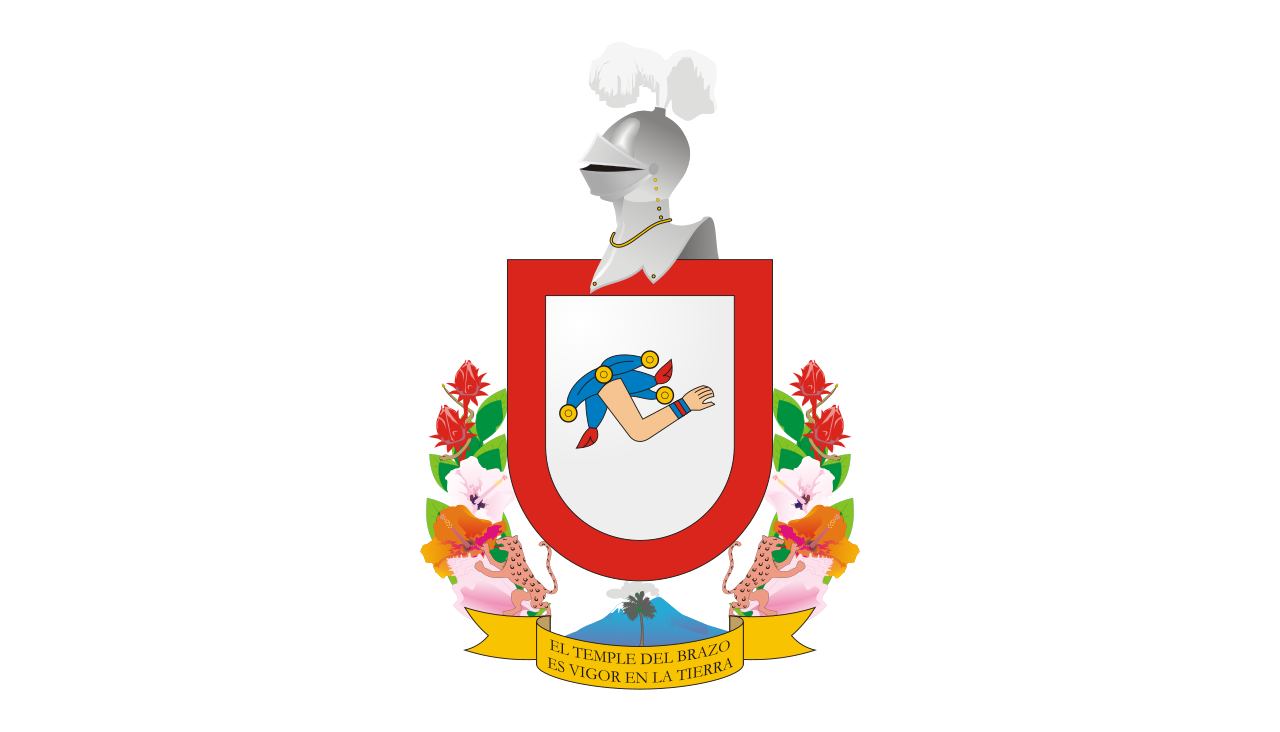
A bare forearm in a blue, gold-studded sleeve bends inside a red-rimmed white shield crested by a plumed helm; jaguars, hibiscus and a volcano sit below.
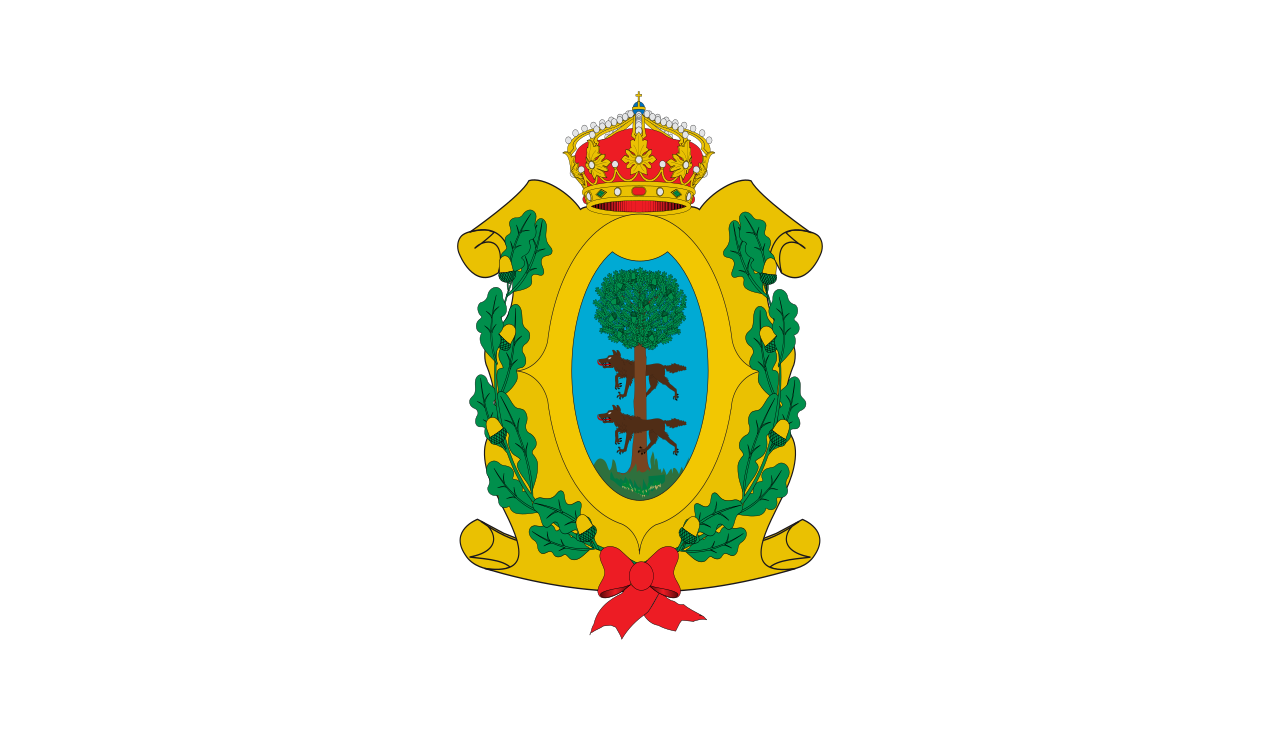
Durango
A crowned gold shield framed by oak leaves and tied with a red bow; on the sky-blue centre two brown wolves stand against a green tree.
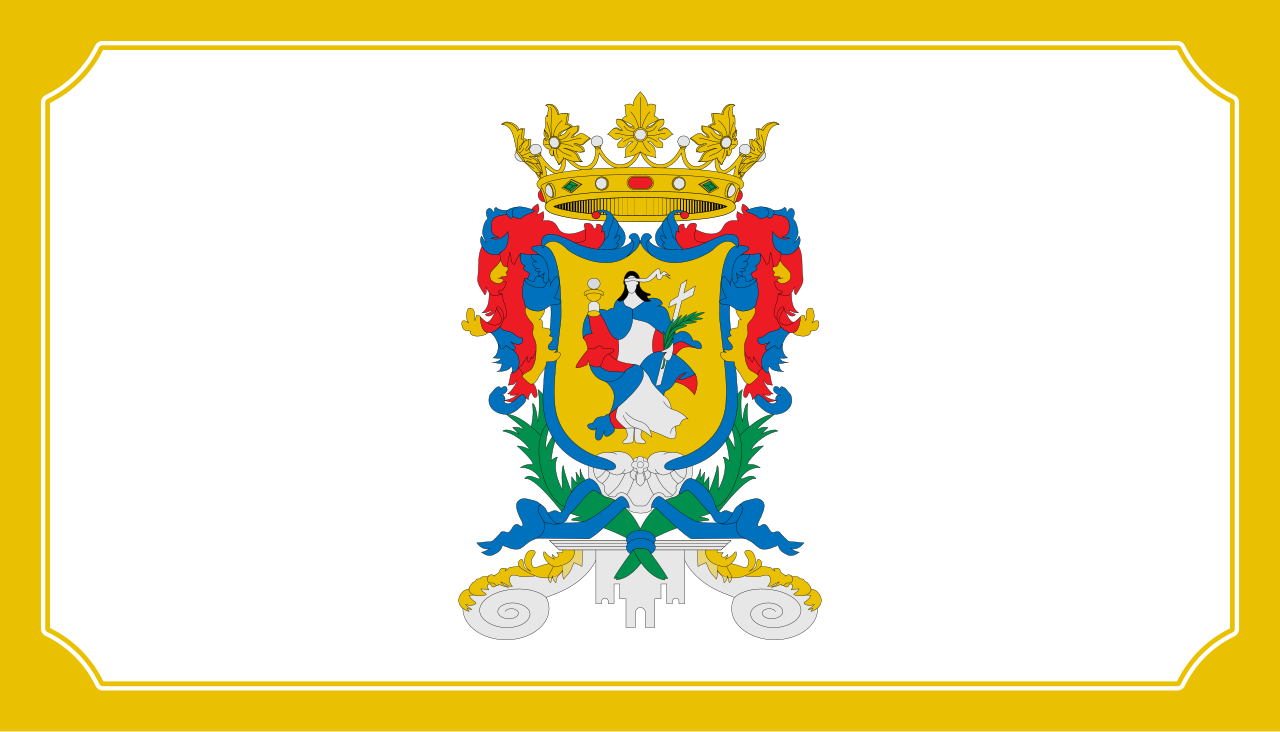
Guanajuato
White inside a gold border, with arms showing a woman in blue and white robes holding a palm frond on a gold shield beneath a golden crown.
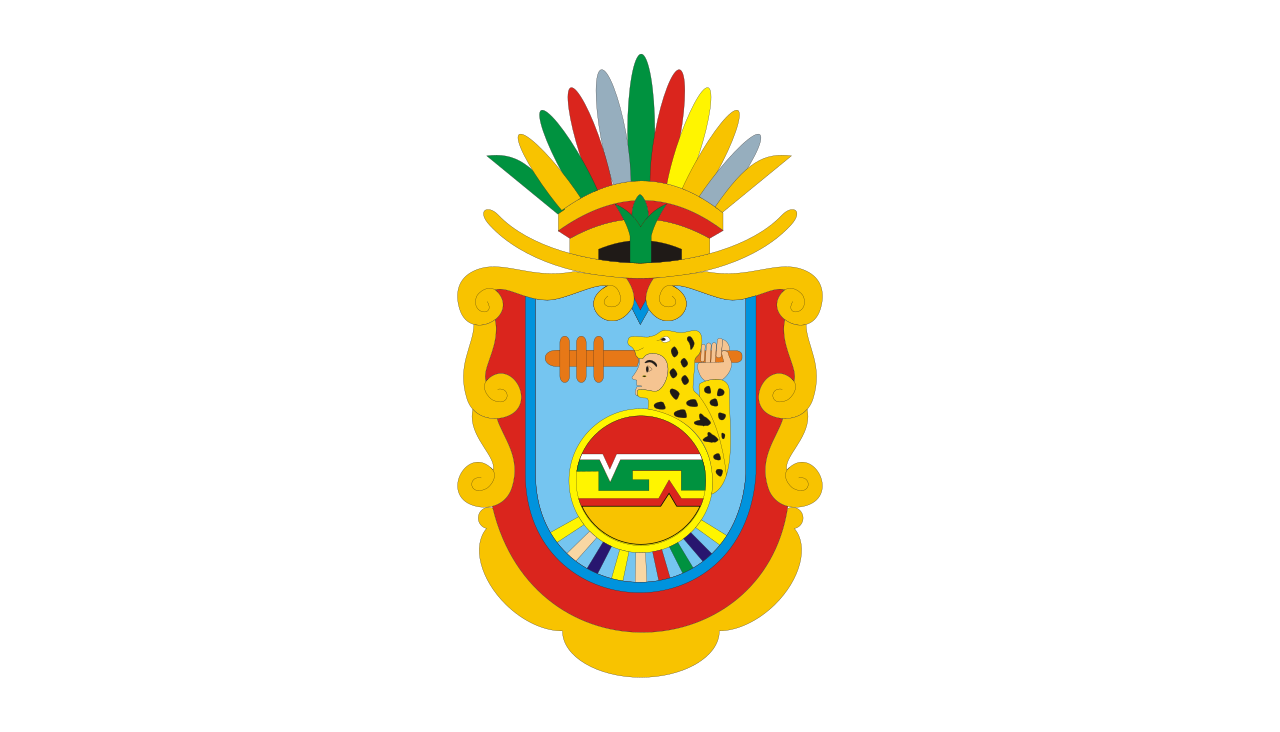
Guerrero
On white, a warrior in a spotted jaguar skin raises a club; below him a gold disc carries a red-and-green step pattern, and feathers fan out overhead.
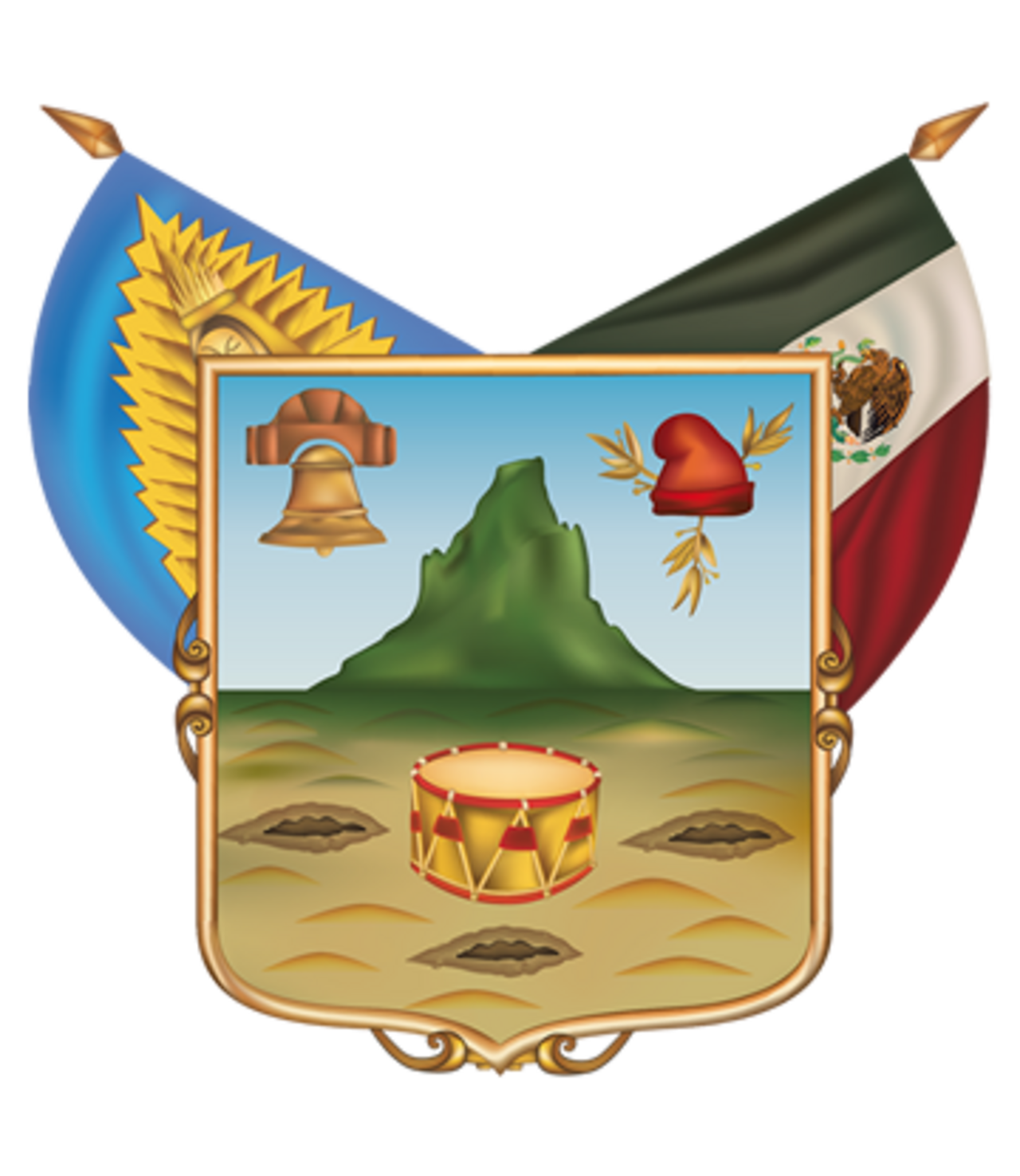
Hidalgo
Behind the shield cross a blue flag with a golden sun and the Mexican tricolour; inside are a bell, a green hill, a red Phrygian cap with wheat, and a drum.
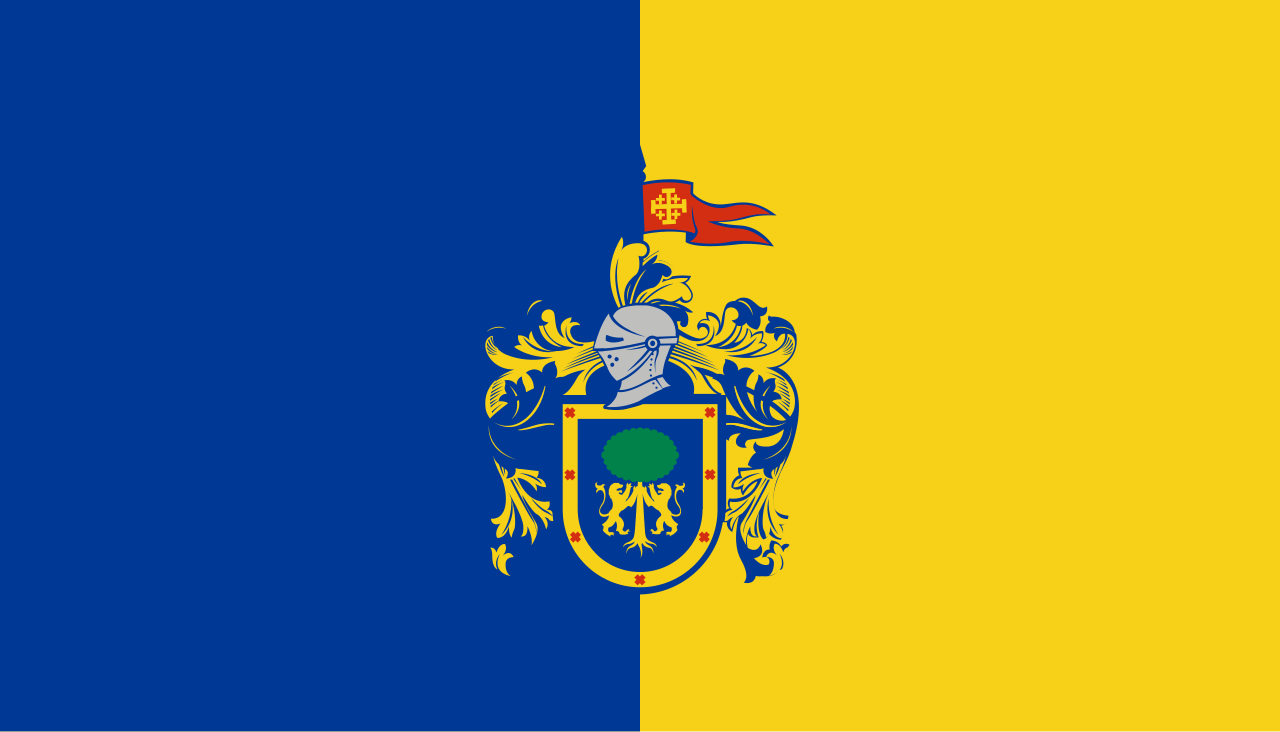
Jalisco
Blue at the hoist, yellow at the fly, with the arms astride the seam: two gold lions rear beside a round green tree under a steel helmet and a red pennant.
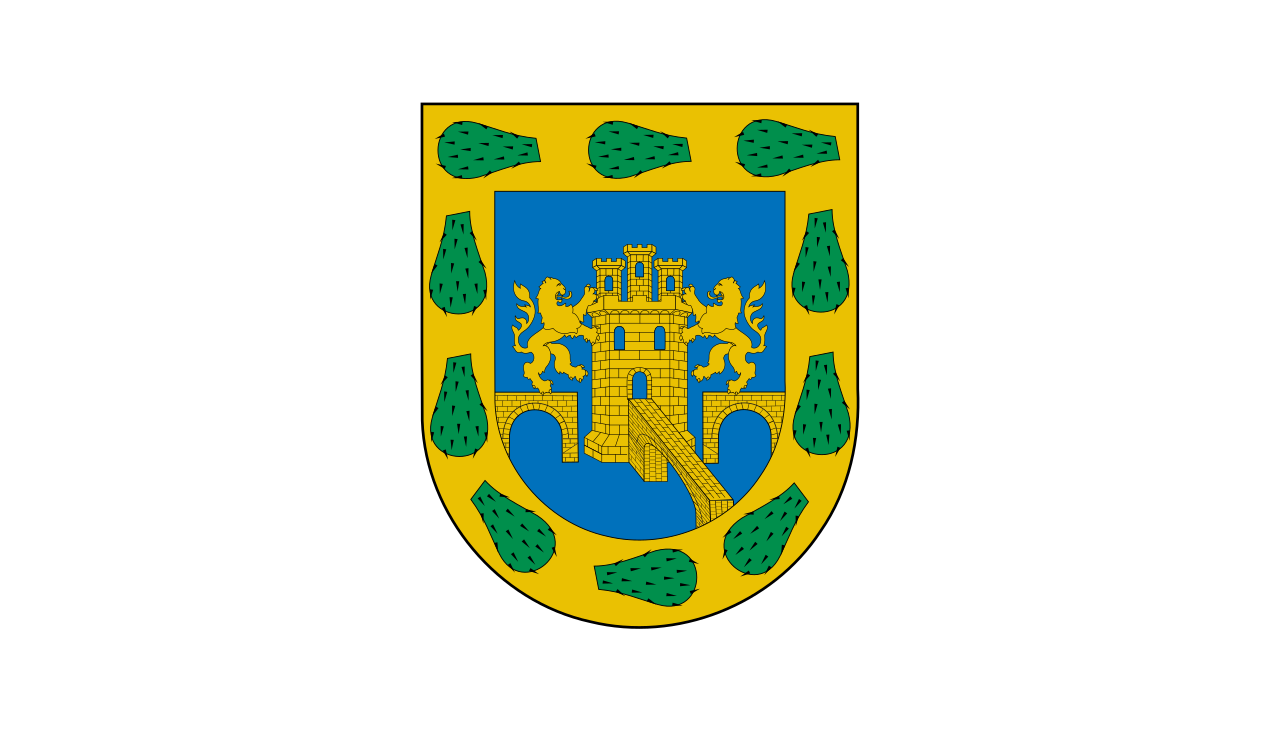
Mexico City
Green prickly-pear pads ring a gold shield; at its heart a gold castle on blue stands on a three-arched bridge, guarded by two rearing gold lions.
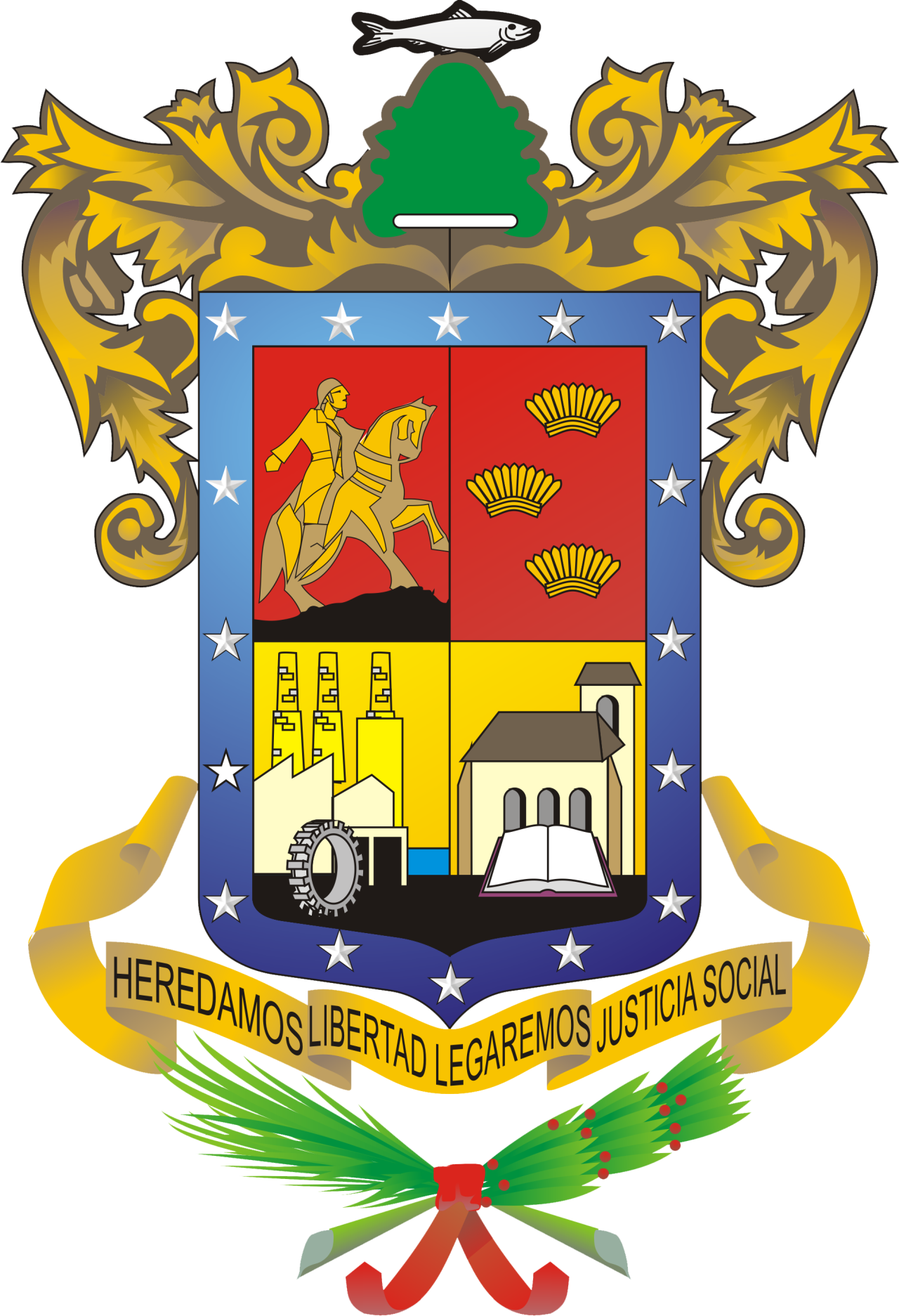
Michoacán
Four quarters — a gold horseman, three gold crowns, a factory with a cogwheel, a church over an open book — in a star-studded blue border, a white fish on top.
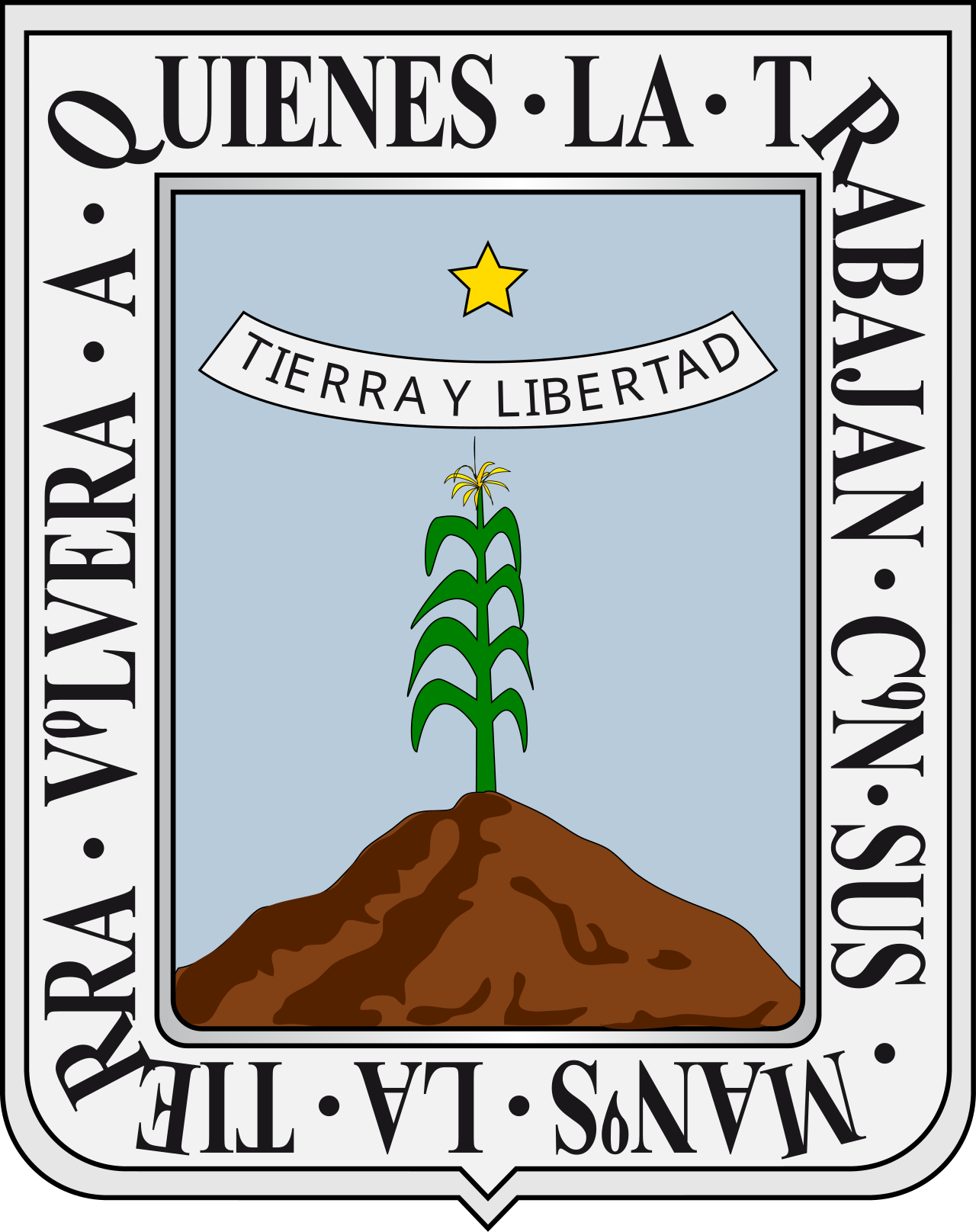
Morelos
Round the silver border runs a motto in black capitals; within, a green maize plant grows from brown earth under a gold star and a TIERRA Y LIBERTAD scroll.
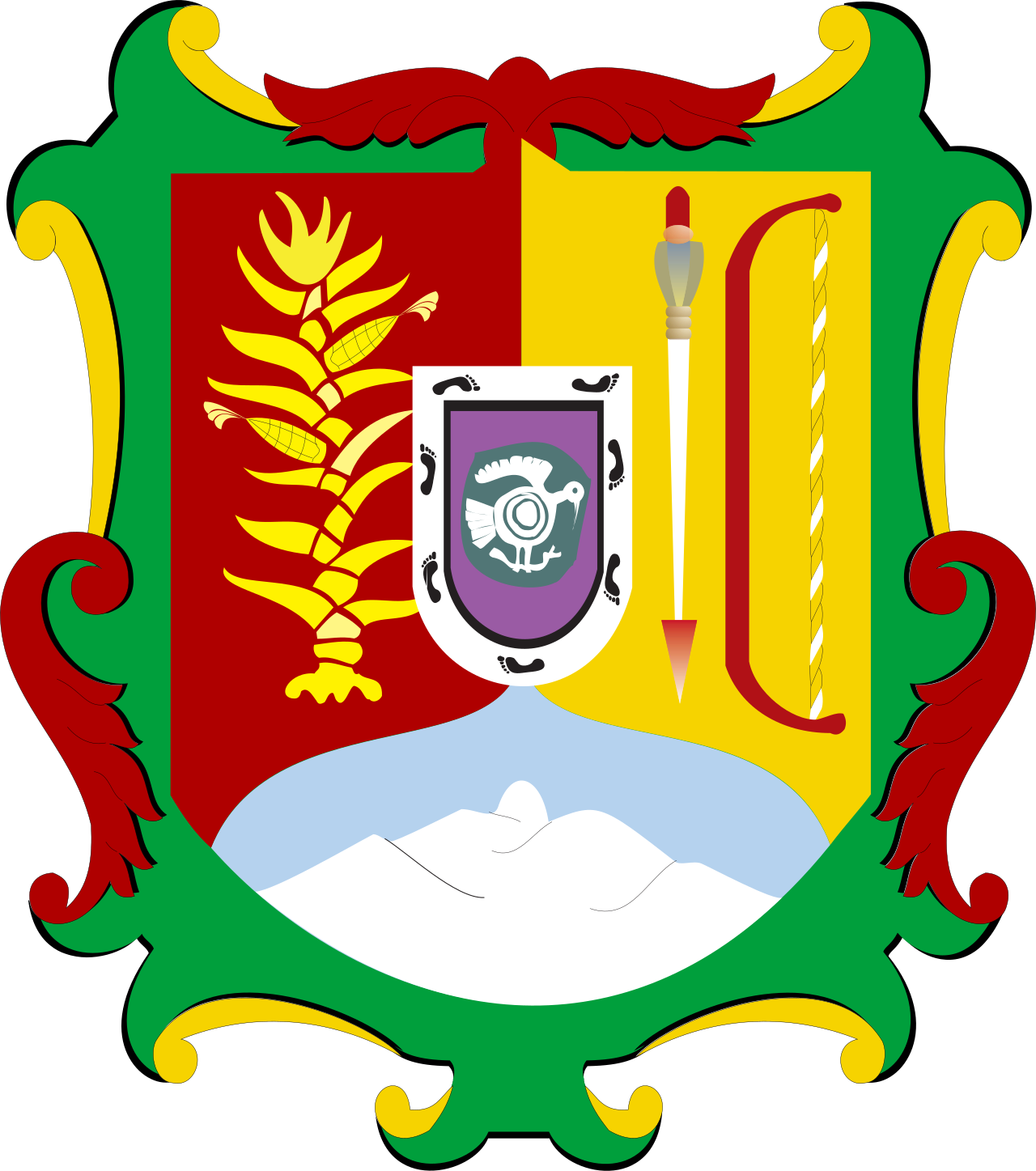
Nayarit
A red half with a gold maize plant, a yellow half with a bow and arrow, white peaks below, and a small centre shield ringed with footprints holding an eagle.
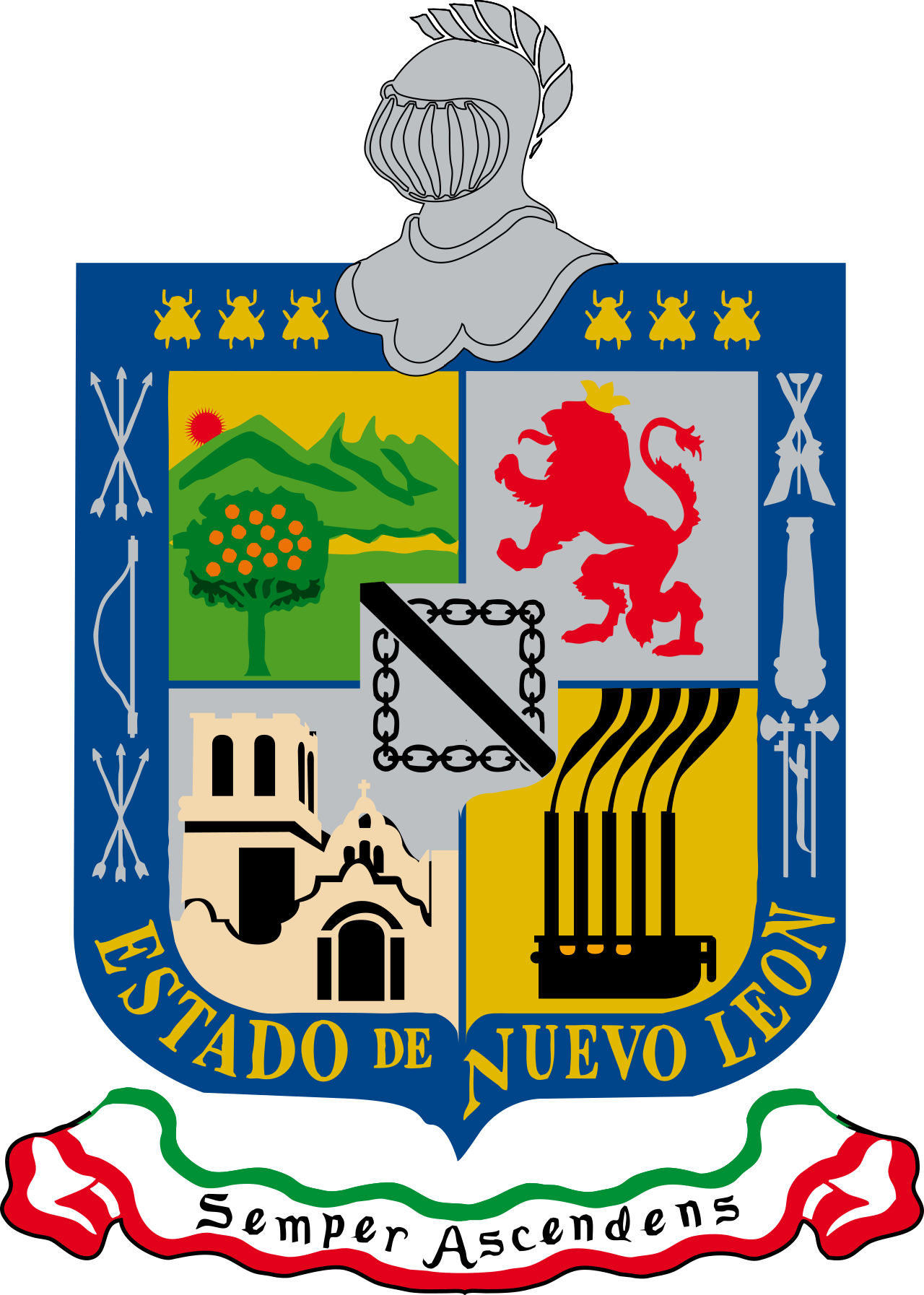
Nuevo León
Four quarters pack in a red crowned lion, an orange tree below green ridges, a colonial church and a foundry with five smoking chimneys; the motto reads Semper Ascendens.
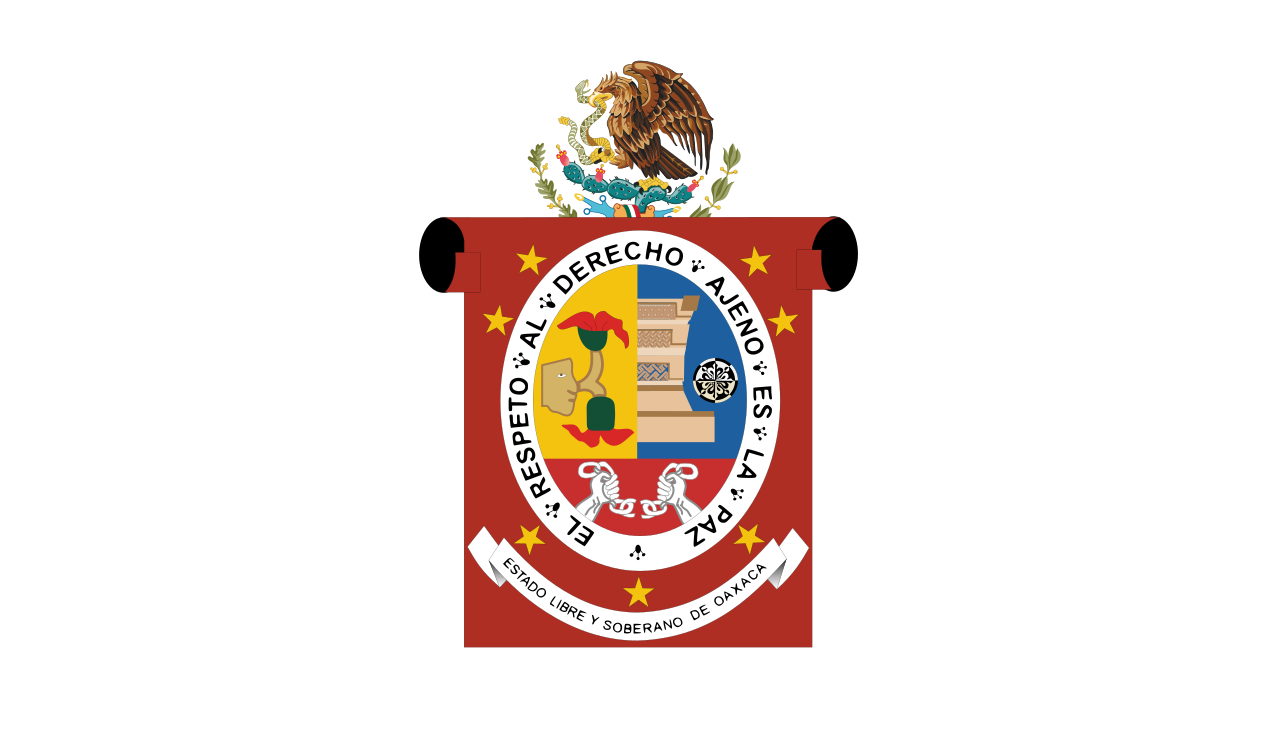
Oaxaca
On a red banner, a white ring carries the motto 'El respeto al derecho ajeno es la paz' around Mitla's fret-carved stonework and two hands snapping a chain.
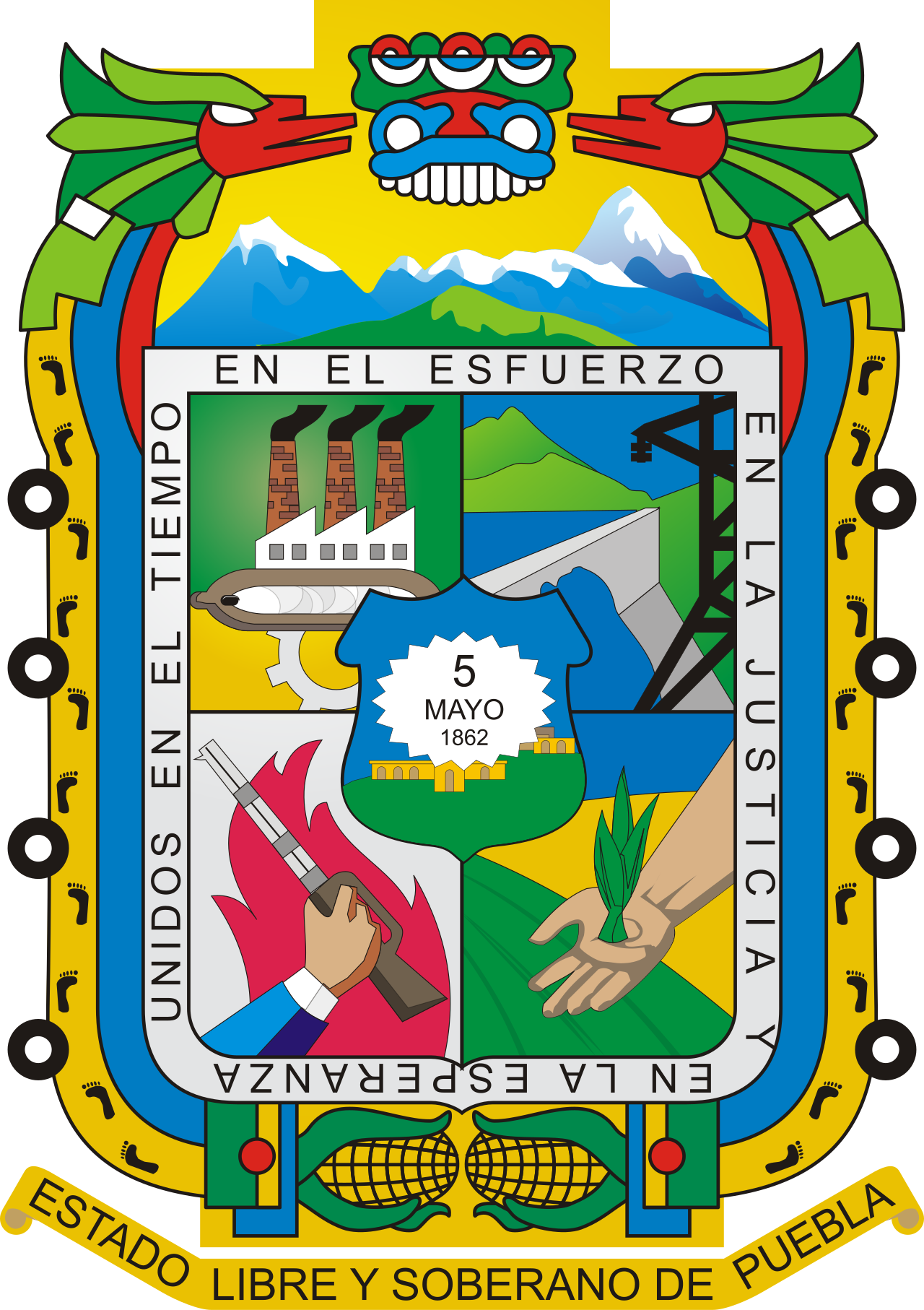
Puebla
Feathered serpents crown a shield of snowy volcanoes, smoking factories and a dam; a white starburst at the heart marks 5 Mayo 1862, with maize cobs at the foot.
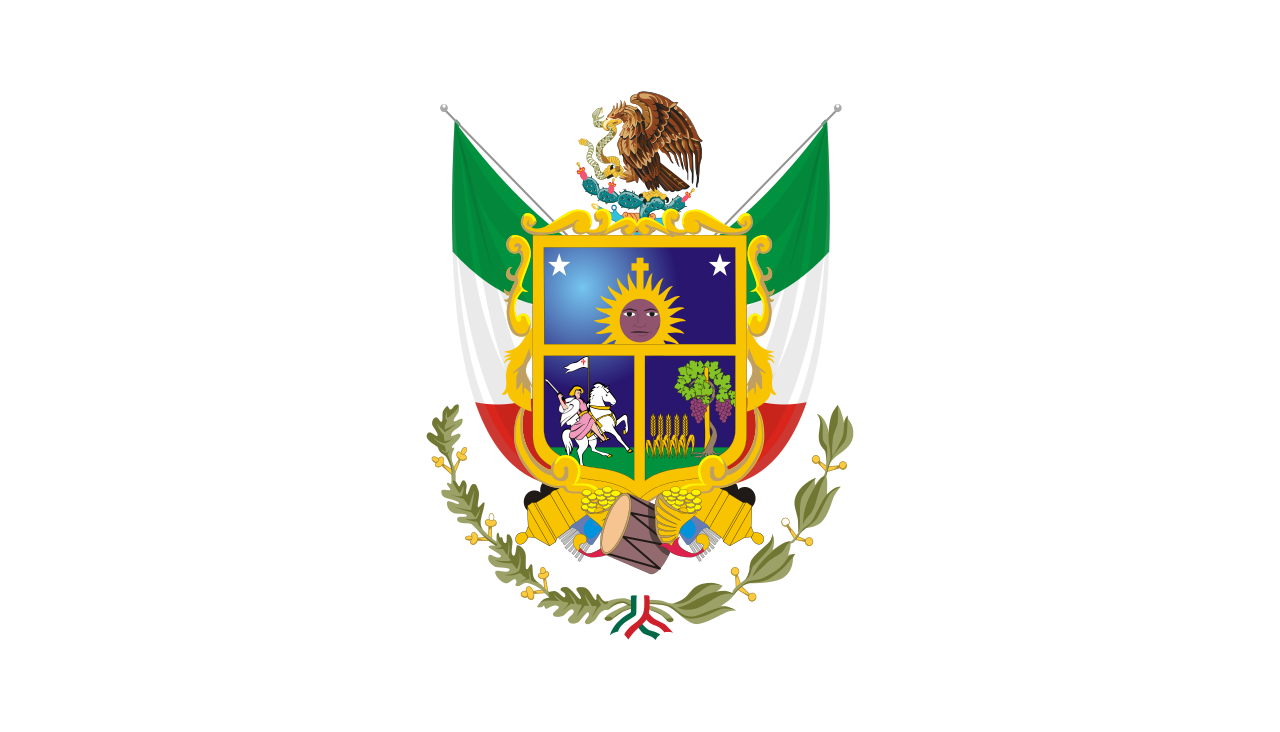
Querétaro
Between two crossed Mexican flags sits a gold-framed shield: a sun with a human face beneath a cross, a rider on a white horse, and a tree with grapes and wheat.
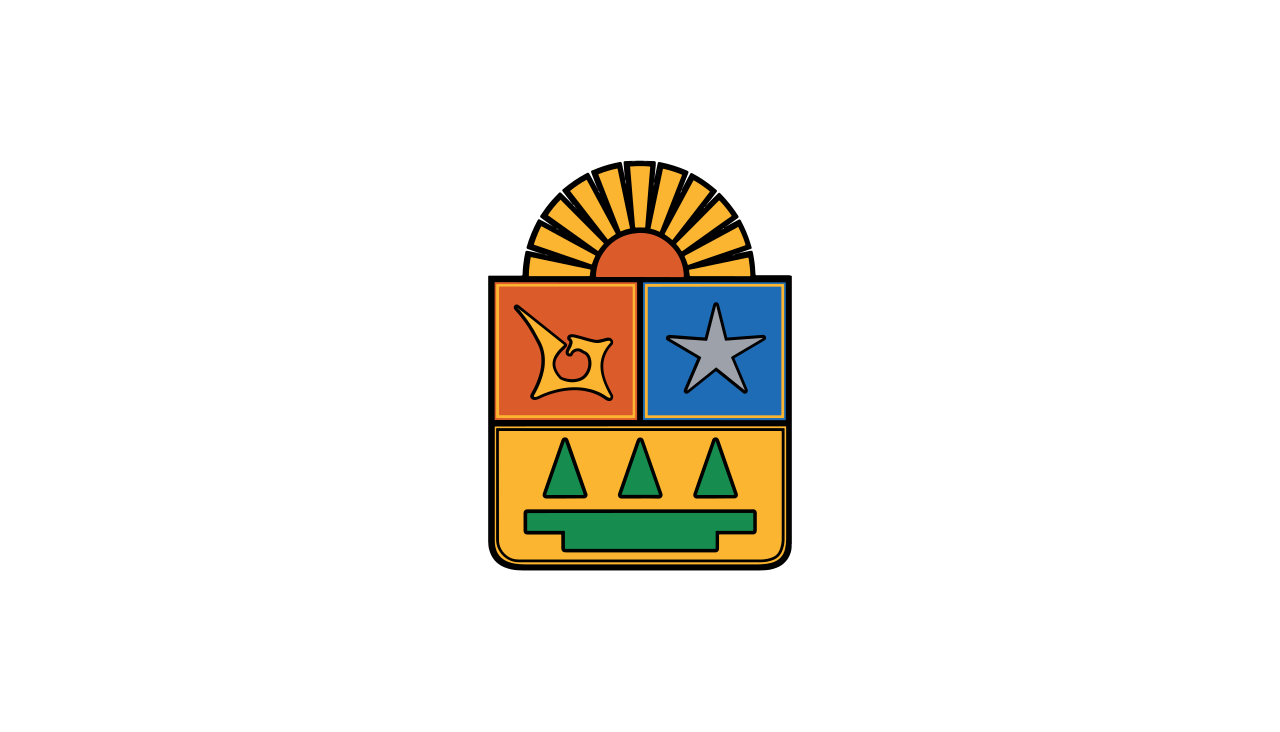
Quintana Roo
Gold rays fan from a rising half sun above three panels: a spiral device on orange, a grey five-pointed star on blue, and three green triangles on yellow.
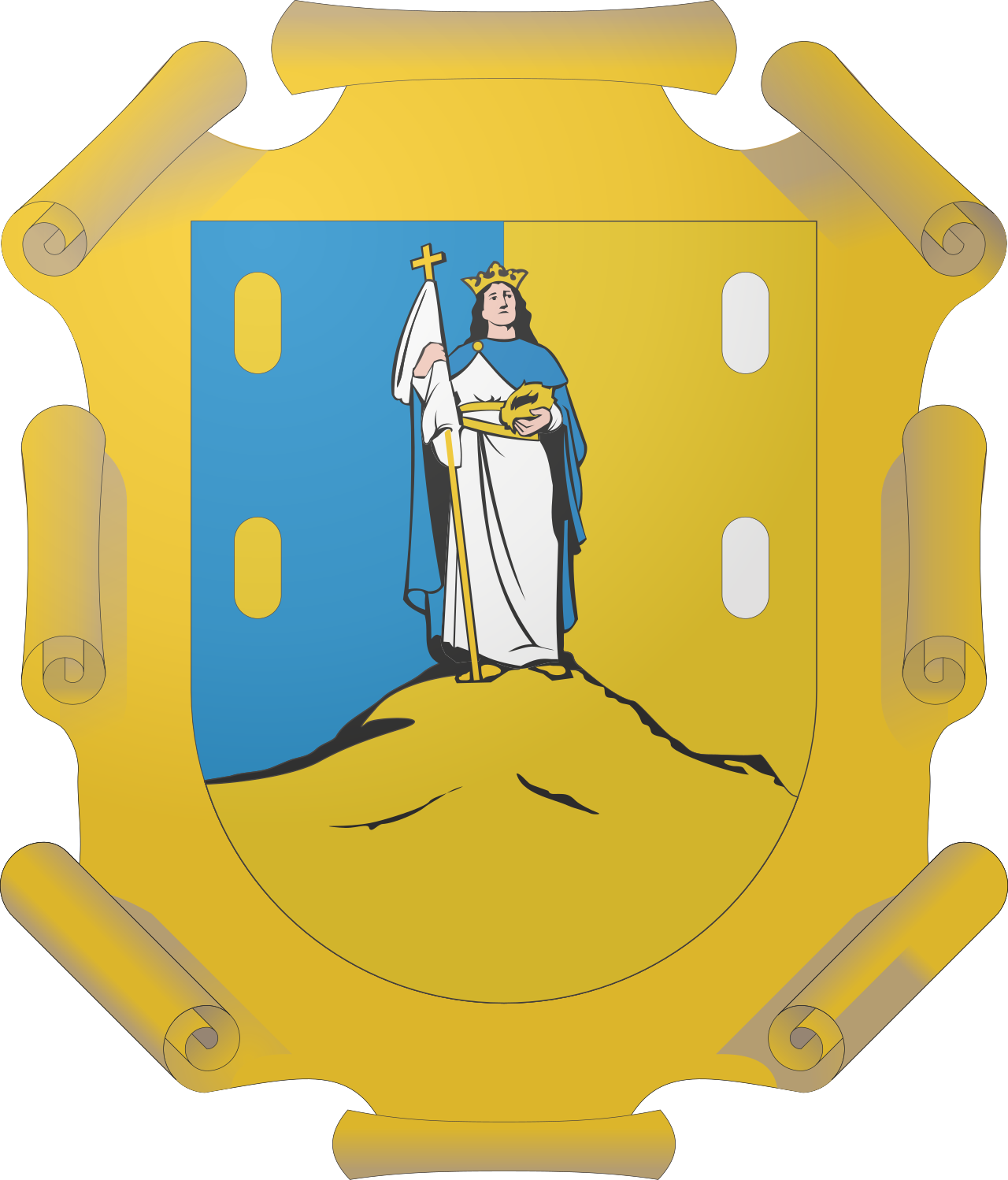
San Luis Potosí
Split blue and gold, the field shows a crowned figure in white robe and blue cloak on a gold hill with a cross-topped banner, flanked by gold and silver bars.
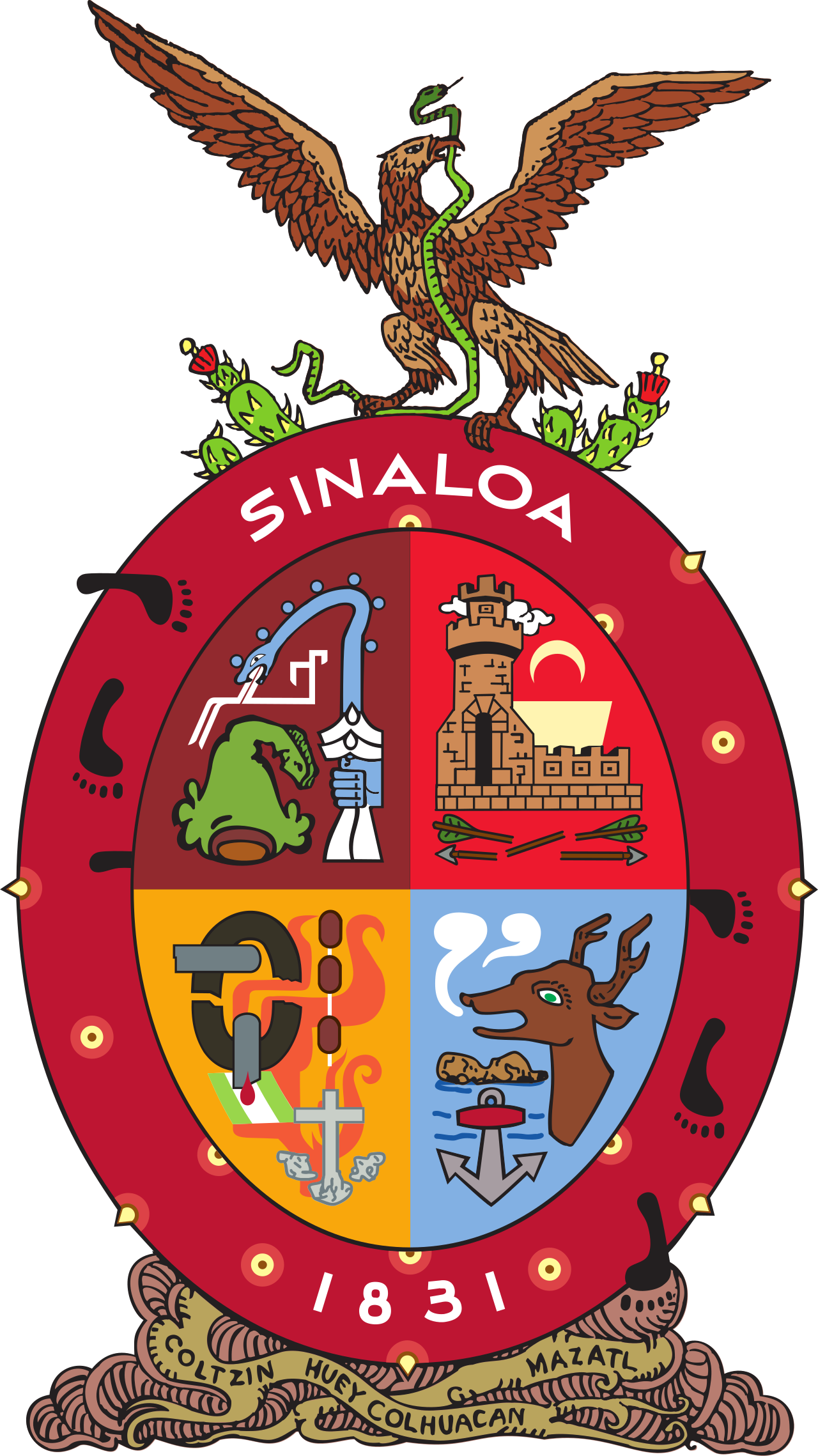
Sinaloa
SINALOA arcs over a red oval with four quarters: an old place-glyph of a blue serpent arching over a green hill, a stone tower with crossed arrows, a cannon amid flames, and a deer's head above an anchor; 1831 sits at the foot.
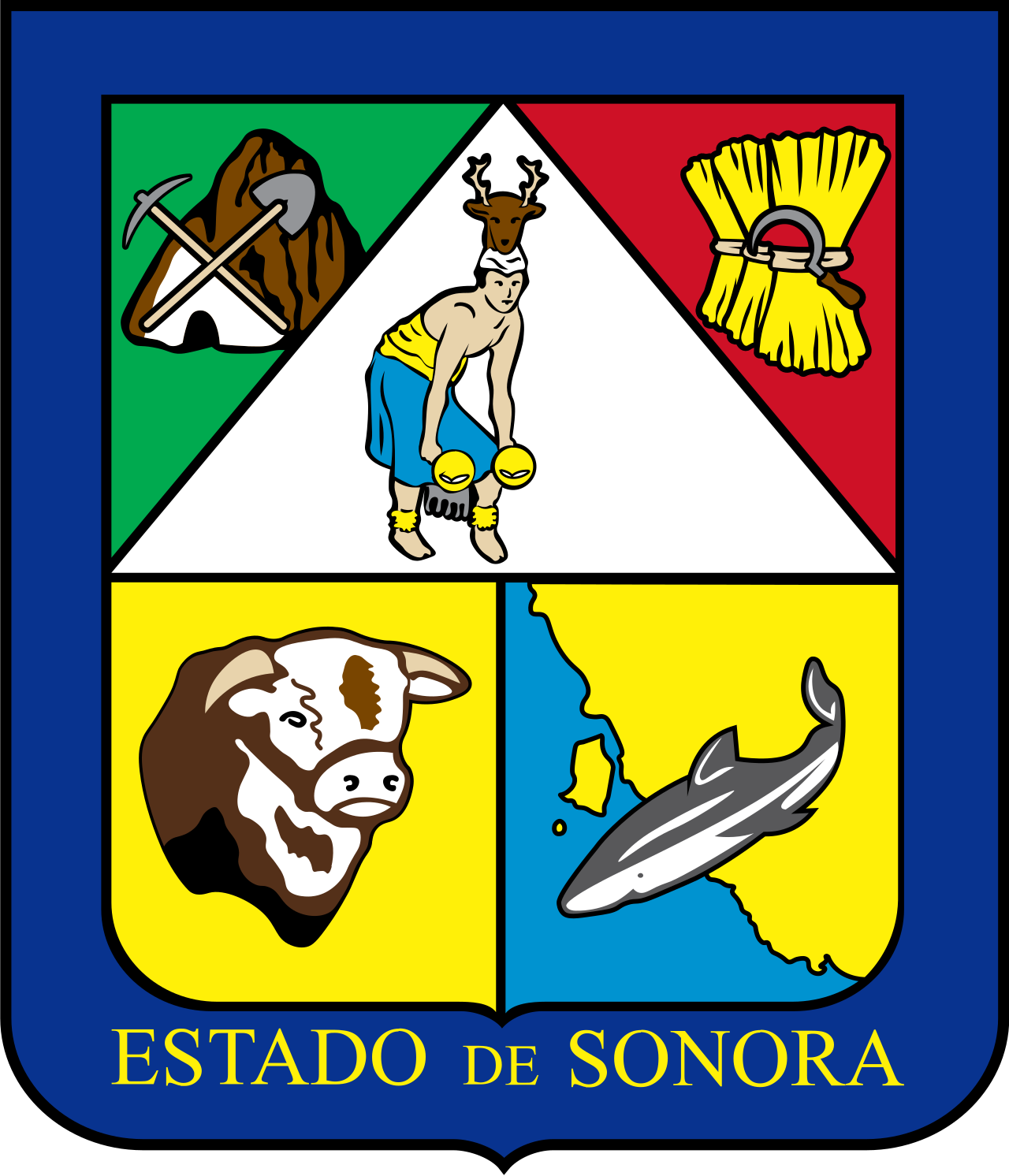
Sonora
In the white centre a deer dancer shakes gourd rattles, ringed by a mine with pick and shovel, a bound wheat sheaf, a bull's head and a shark off the coast.
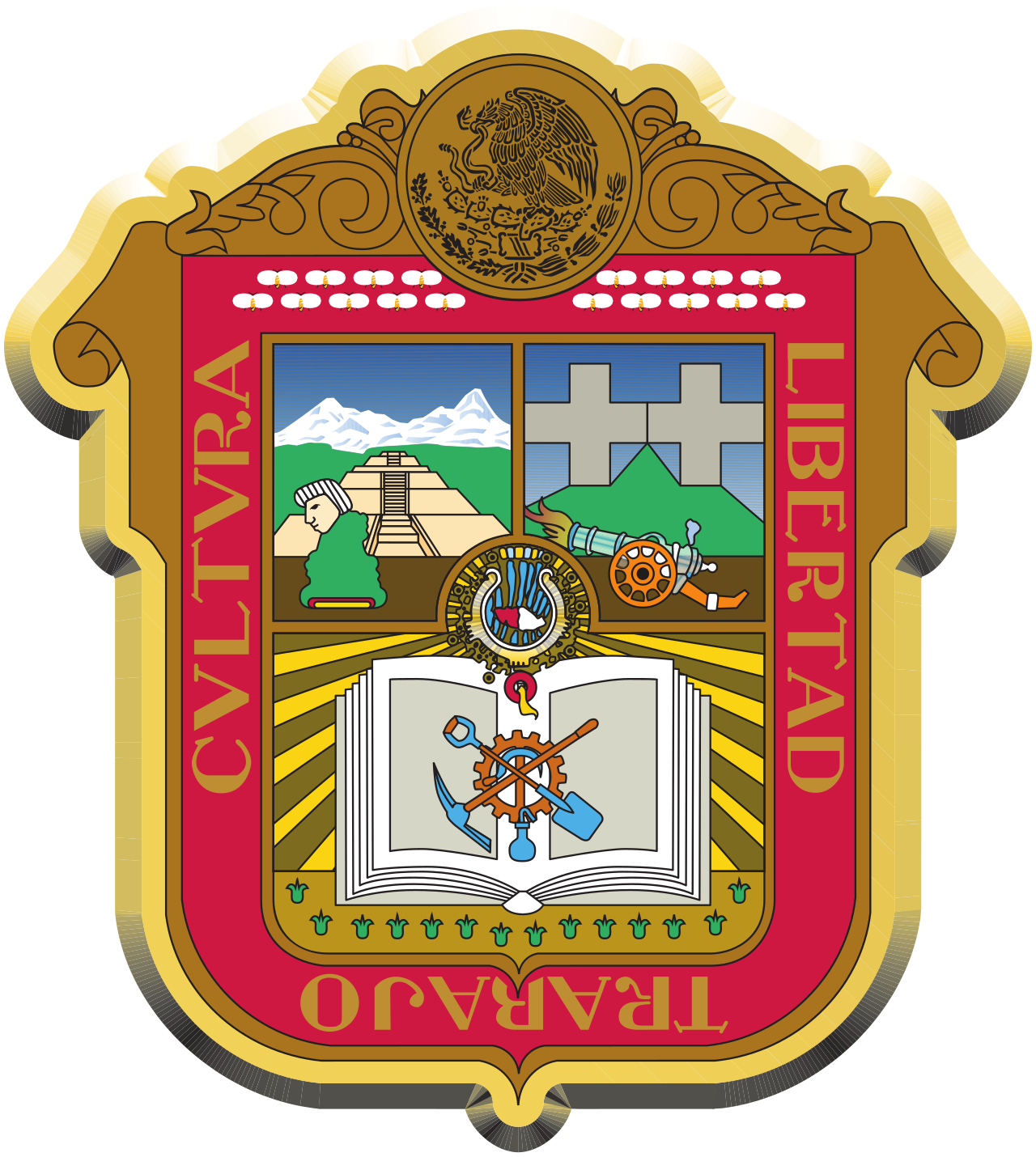
State of Mexico
The gold rim reads Cvltvra, Libertad, Trabajo around a step pyramid, two crosses with a cannon on a green hill, and an open book with pick, shovel and gearwheel.
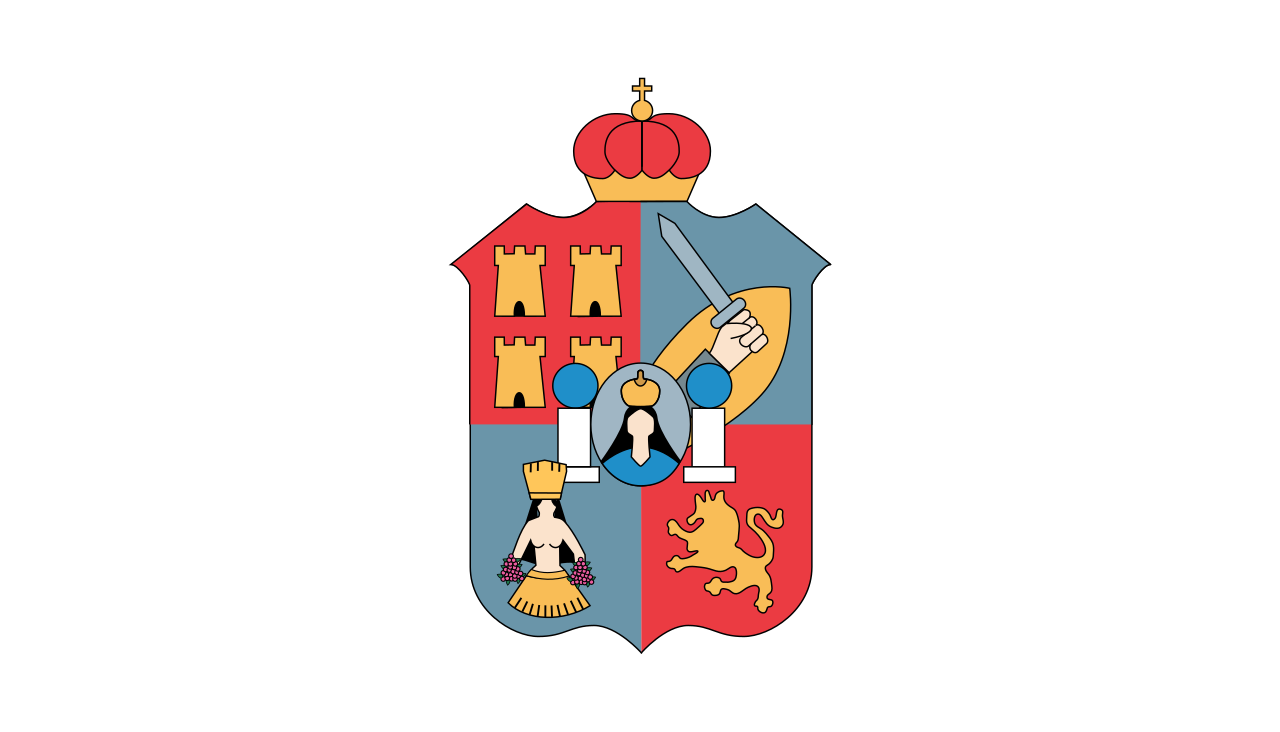
Tabasco
On white, a crowned shield quartered red and slate blue: four gold towers, an arm with a sword, a gold lion, and an indigenous woman holding flowers.
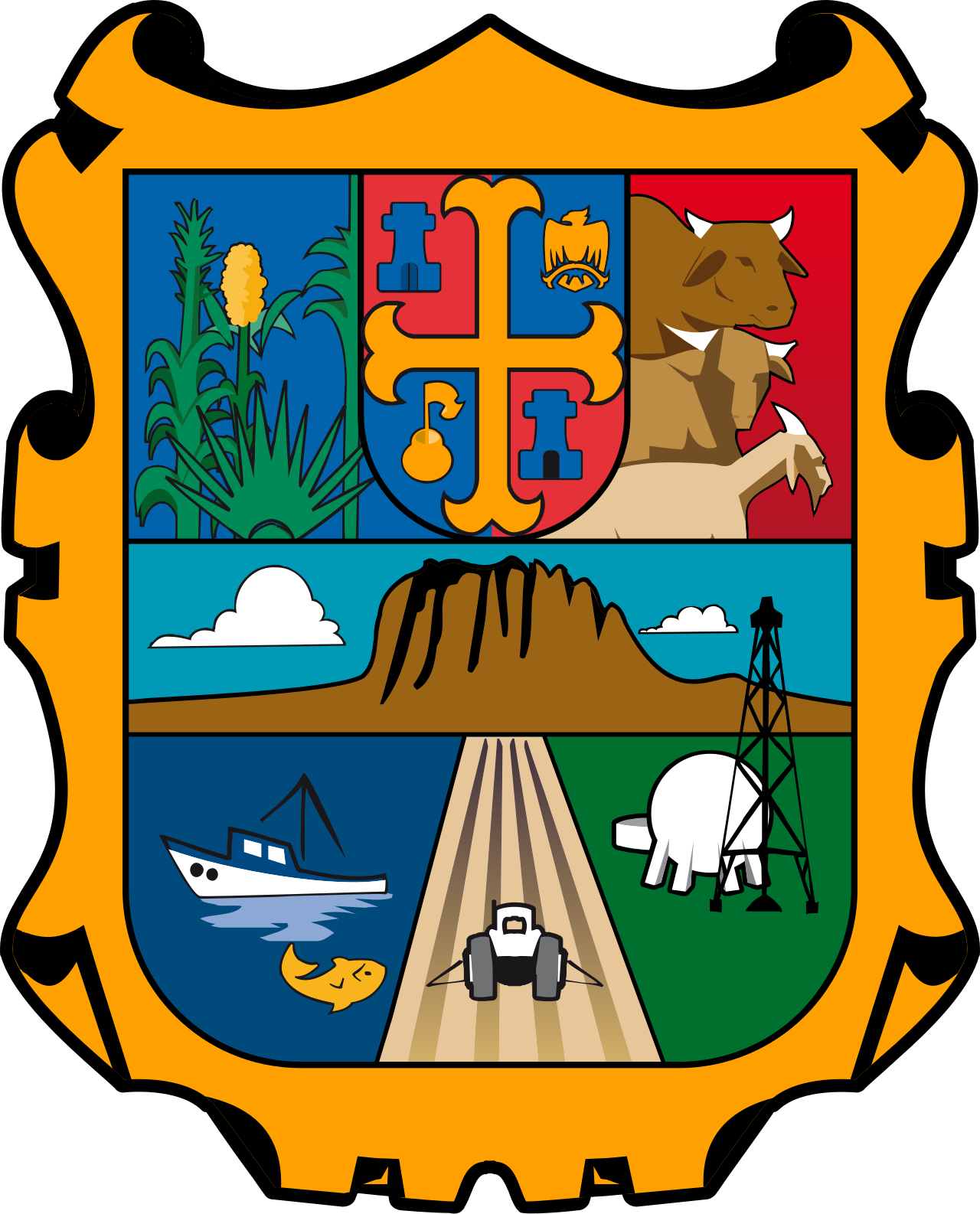
Tamaulipas
Inside a scrolled gold frame: maize and agave, a brown bull, a fishing boat and fish, a tractor, a sheep, and an oil rig beside a flat-topped mountain.
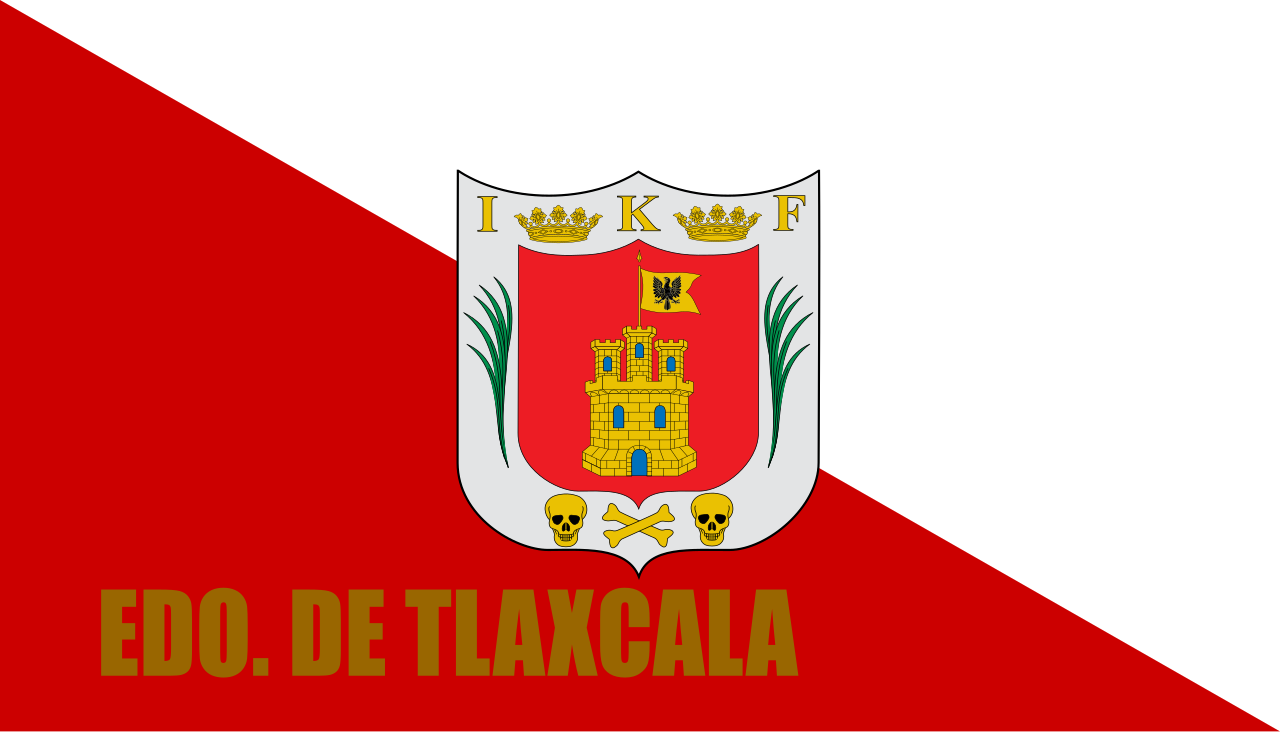
Tlaxcala
Split corner to corner in red and white; its shield bears the crowned letters I, K and F, a gold castle under an eagle banner, and skulls on crossed bones.
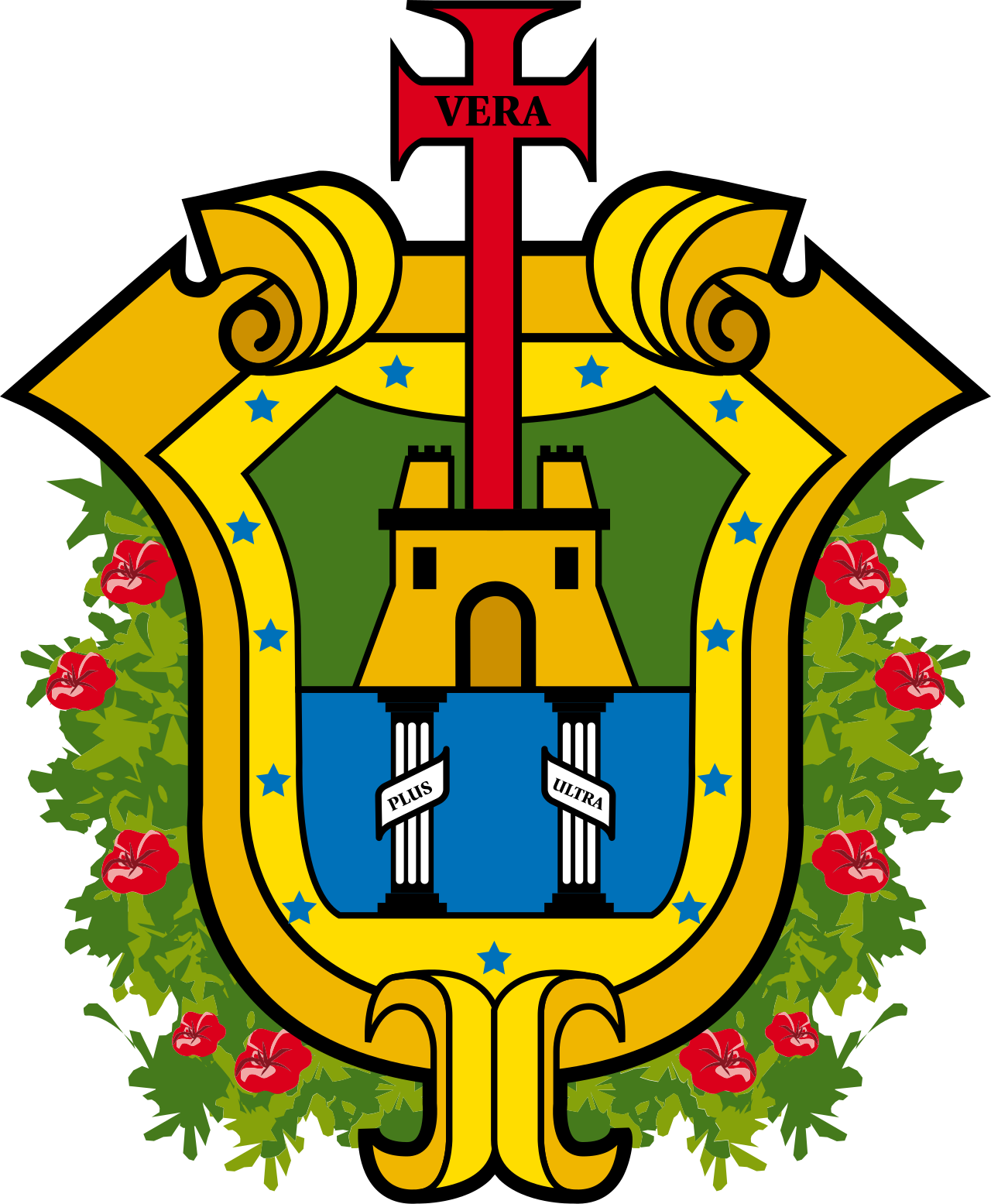
Veracruz
A gold castle rises beneath a red cross, over two white PLUS ULTRA columns on blue; blue stars ring the gold border inside a wreath of red flowers.
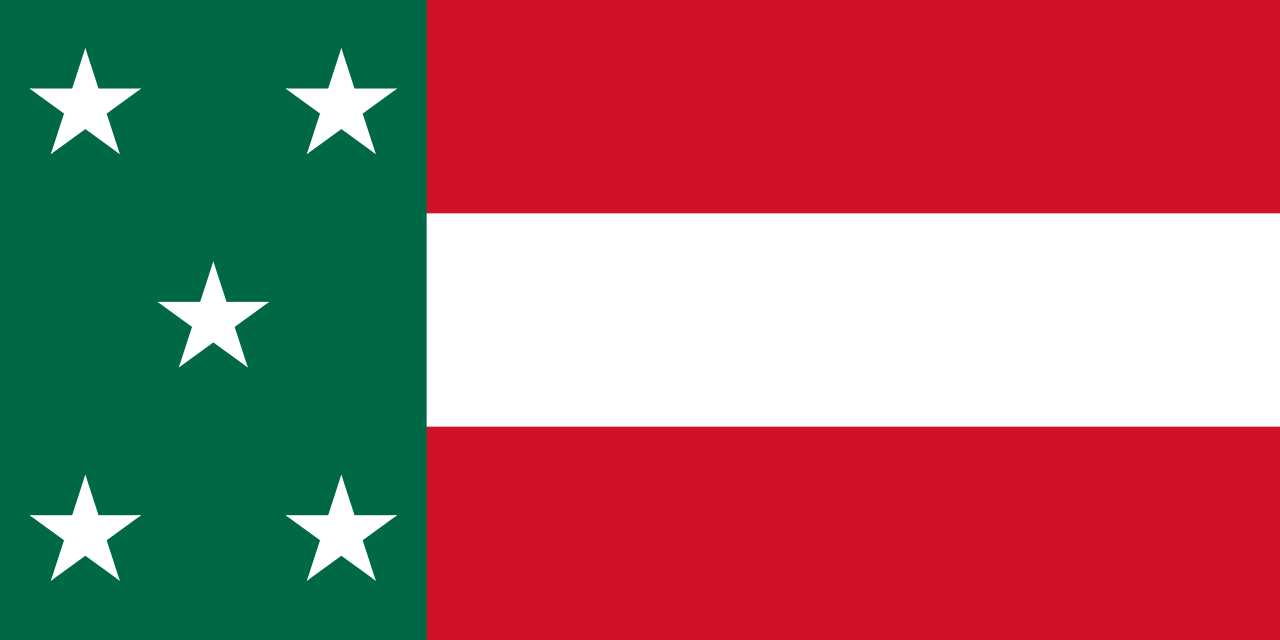
Yucatán
Five white stars fill the green hoist panel, one at each corner and one in the middle, beside three stripes of red, white and red.
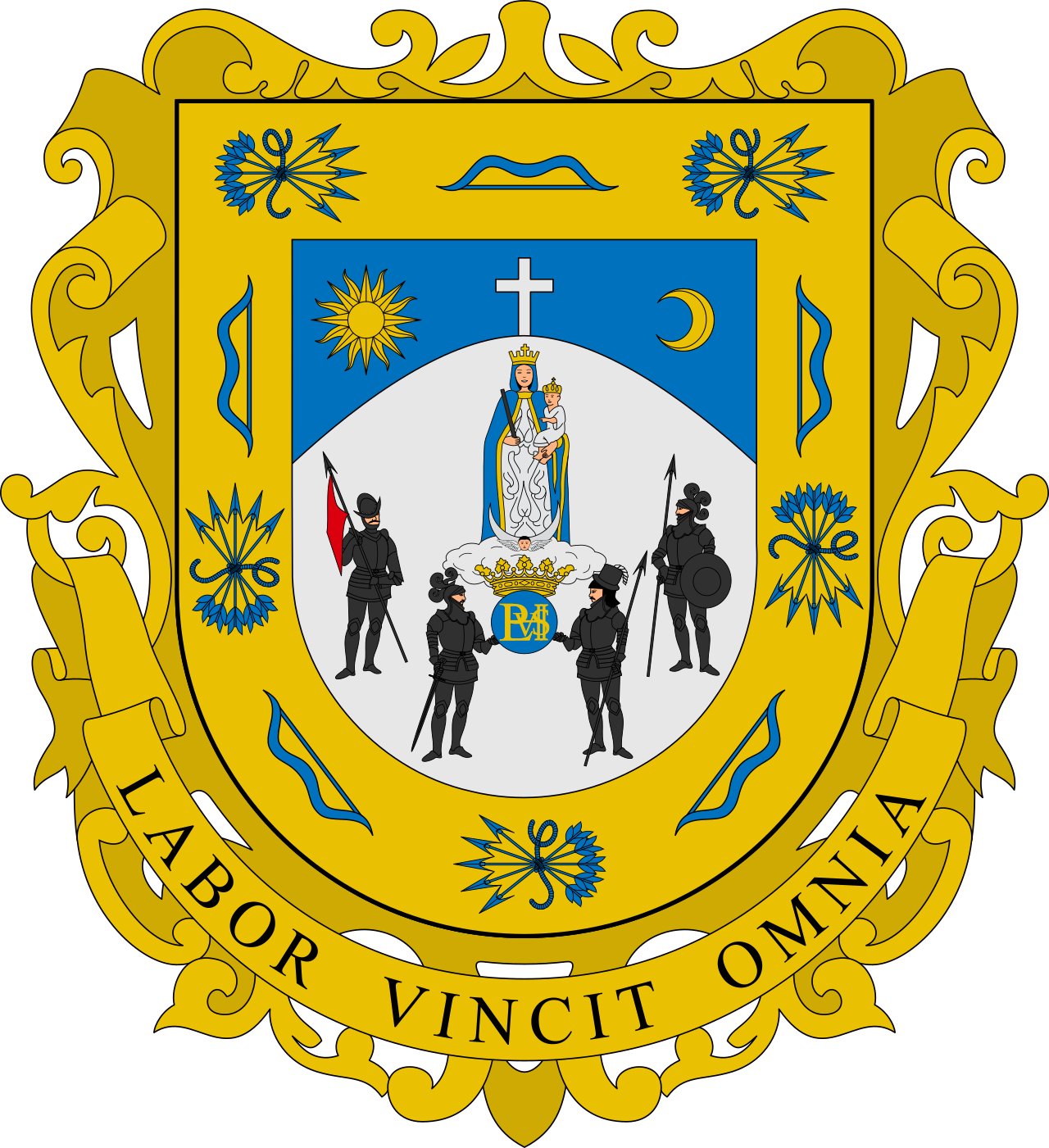
Zacatecas
The Virgin and Child hover above four Spanish soldiers in black armour, a gold sun and crescent moon flanking them; the scroll reads LABOR VINCIT OMNIA.
Data Sources
- What the flag means: Ley sobre el Escudo, la Bandera y el Himno Nacionales (DOF 08-02-1984), Artículo 3
- Population: Population, total (SP.POP.TOTL), latest available value
- Area: World countries in JSON, CSV, XML and YAML
- Organizations: Membership of Principal UN Organs
- Organizations: Members and partners