Flag of Wallis and Futuna
What the flag means
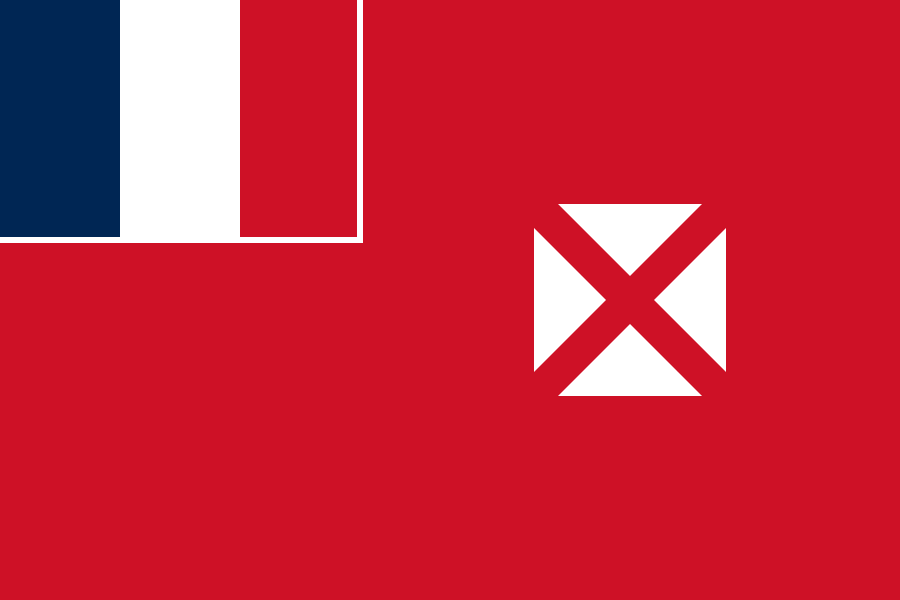
- Four white triangles — the three kings of the islands and the French administrator
- Tricolour in the canton — French sovereignty
- Widely used but never enacted — the official flag remains the French tricolour
No law defining the design was found.
Highlights
- 🏝️ Pristine South Pacific isles
- 🌊 Clear emerald lagoons
- 🌋 Mysterious volcanic lakes
- 🥥 Traditional Polynesian life
- 🌴 Quiet palm-lined beaches
Quick facts
- Region
- Oceania · Polynesia
- Status
 French Overseas Collectivity
- Population
- 11,000 people (2025)
- Area
- 142 km²
- Capital
- Mata-Utu
- Languages
- French
- Currency
- CFP franc (XPF)
Symbols in History (1)
Coats of arms and emblems whose historic seat lies within this country’s present-day territory.
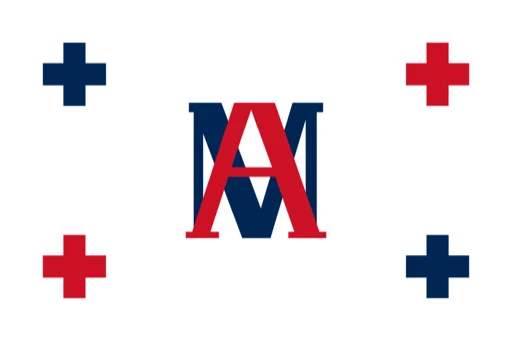
Flag of Uvea (Wallis)
OriginUvea, the Polynesian kingdom on Wallis Island in the South Pacific, flew this flag around the middle of the 19th century. French Catholic missionaries reached the island in the late 1830s, the kingdom became Catholic within a few years, and in 1842 it placed itself under French protection. The picture here is a modern redrawing of that old design.
DescriptionOn a plain white field, a navy blue M and a red A are laid one over the other in the centre. The A stands in front, and its top is flat rather than pointed: it ends in a straight bar that drops into the gap between the two uprights of the M, so the letters close on one line above and stand on one line below. A bar crosses the A halfway down, and beneath it the middle wedge of the M shows between the red legs. Read together the two make a single mark - the old monogram of the Virgin Mary. A small cross with four arms of equal length sits in each corner: navy at the top left and bottom right, red at the top right and bottom left, so matching colours face each other along the diagonals. Nothing else is drawn; the white ground is left bare.
