Flag of French Polynesia
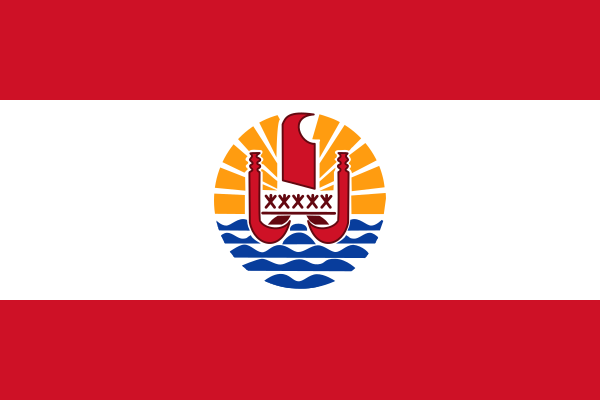
What the flag means
- Red and white stripes — traditional Tahitian colors of victory and purity
- Central emblem — an outrigger canoe with five figures for the five island groups
No law defining the design was found. · Adopted 1984
Highlights
- 🏝️ Bora Bora's dreamy lagoon
- 🏨 Overwater villas on the lagoon
- 🎨 Tahiti scenes Gauguin loved
- 🌺 Tiare flowers and black pearls
- 💃 Lively Polynesian dance
Quick facts
- Region
- Oceania · Polynesia
- Status
 French Overseas Collectivity
- Population
- 282,465 people (2025)
- Area
- 4,167 km²
- Capital
- Papeete
- Languages
- French, Tahitian
- Currency
- CFP franc (XPF)
Symbols in History (4)
Coats of arms and emblems whose historic seat lies within this country’s present-day territory.

Arms of the House of Pomare
OriginThe Pomare dynasty ruled Tahiti and the neighbouring islands from the end of the 18th century until 1880, when the last king handed the kingdom over to France. Through the 19th century the Tahitian court was in constant contact with European missionaries and navies, and it took up the European signs of monarchy — a shield and a crown — as the mark of the ruling house, while the kingdom's flag carried the same red and white. The drawing shown here is a modern single-colour redrawing of that emblem.
DescriptionA red crown floats at the top. Its upper edge sweeps up into a broad rounded corner at each side and sinks into a deep V in the middle; the crown itself is drawn with one thick band, so two large white fields are left open inside it, and a plain red bar carries the whole thing from below. At the very summit a small globe carries a cross. That cross-topped globe is the orb, the sign of Christian kingship in European royal imagery. Beneath it stands a shield: a red frame around a plain white field, with one large red serif capital P at its centre, the initial of Pomare, while the foot of the shield curls inward on both sides and meets in a small point.

Flag of Huahine
OriginHuahine is one of the Leeward Islands of the Society group, and through the nineteenth century it kept its own ruling house instead of joining the Pōmare kingdom of Tahiti. When Tahiti came under a French protectorate in the 1840s, an Anglo-French agreement left the Leeward Islands outside it, so Huahine flew its own colours as a separate kingdom until France annexed the group late in the century. The image here is a modern vector drawing of that design.
DescriptionThree equal horizontal bands fill a 3:2 rectangle: white along the top, a deep red band across the middle, white again along the bottom. Nothing else appears on the cloth — no crest, no star, no lettering — so the whole flag rests on where the red is placed. In the Society Islands red carried the highest rank, the colour of the maro ʻura, the red feather girdle worn by paramount chiefs, and here it holds the centre with white framing it above and below. Tahiti's flag sets the same two colours the other way round, red-white-red, which kept the neighbouring islands easy to tell apart at sea.
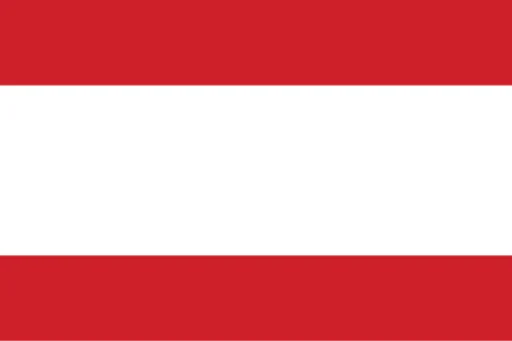
Flag of the Kingdom of Tahiti
OriginThis was the flag of the Kingdom of Tahiti under the Pomare dynasty, the line that ruled the island through the nineteenth century. Settled in the 1820s, it stood for the kingdom on its ships and in its dealings with foreign powers. Tahiti passed under a French protectorate in 1842 and was annexed outright in 1880, when the kingdom came to an end. The picture shown here is a modern redrawing of that design.
DescriptionThree horizontal bands fill the field: red along the top, white across the middle, red along the bottom. Each red band is half the height of the white one, a 1:2:1 division that leaves a broad white centre framed by two narrower red edges. Nothing sits on the white, neither crest nor emblem, so the order of the colours alone stands for the kingdom. That red-white-red sequence outlived the kingdom itself and still forms the ground of the modern flag of French Polynesia.
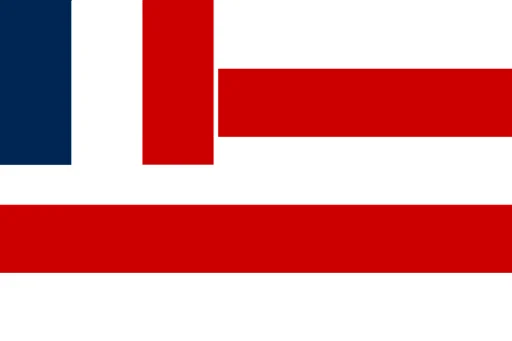
Flag of the Protectorate of Raiatea
OriginThe kingdom of Raiatea, in the Leeward Islands, flew a flag of five alternating white and red stripes. After France annexed Tahiti in 1880 and imposed a protectorate on Raiatea, the French tricolour was set into the upper hoist of that striped flag; it came down in 1888, when the governor proclaimed full French sovereignty over the islands and ordered that only the French flag be raised. The flag survives in a photograph of the time; the picture shown here is a modern redrawing that follows an old flag chart.
DescriptionThe field is divided into five equal horizontal stripes — white, red, white, red, white — so that the two red bands fall in the second and fourth fifths. In the upper hoist sits the French tricolour, three vertical bands of equal width in navy, white and red, covering about two fifths of the length and half the height, its outer edge kept off the red stripe by a thin white line. Because the white band of the tricolour runs straight on into the white of the field, from a distance the canton reads as a navy post and a red post standing side by side. The five stripes are Raiatea's own mark; the tricolour laid over them names the power that had taken charge of the island.


