Flag of South Korea
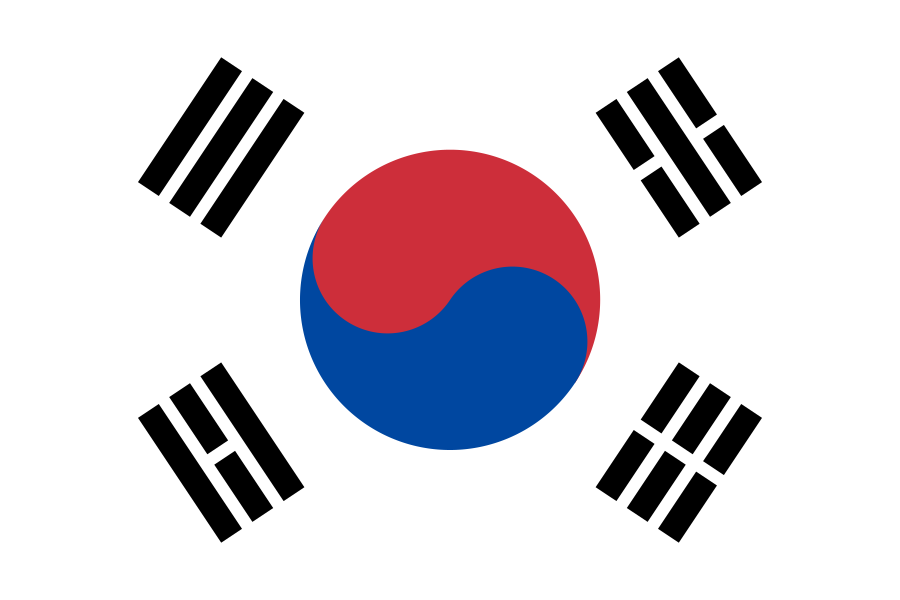
What the flag means
- White field — purity and the people's love of peace
- Taegeuk — harmony of yin (blue) and yang (red)
- Four trigrams — heaven, earth, water and fire
Design set by: 대한민국국기법(법률 제8272호, 2007. 1. 26. 제정) 제4조·제7조 및 같은 법 시행령 · Adopted 1949
Highlights
- 🎵 Home of K-pop and hallyu
- 💻 IT, chip and phone powerhouse
- 📜 5,000 years and the Hangul script
- 🍲 Bibimbap, kimchi, fermented food
- 🛡️ Safe enough to walk at night
Quick facts
- Region
- Asia · Eastern Asia
- Population
- 51,684,564 people (2025)
- Area
- 100,210 km²
- Capital
- Seoul
- Languages
- Korean
- Currency
- South Korean won (KRW)
- Organizations
- United Nations, OECD
Neighboring countries
Land neighbors, approximated from simplified map outlines.
Symbols in History (3)
Coats of arms and emblems whose historic seat lies within this country’s present-day territory.
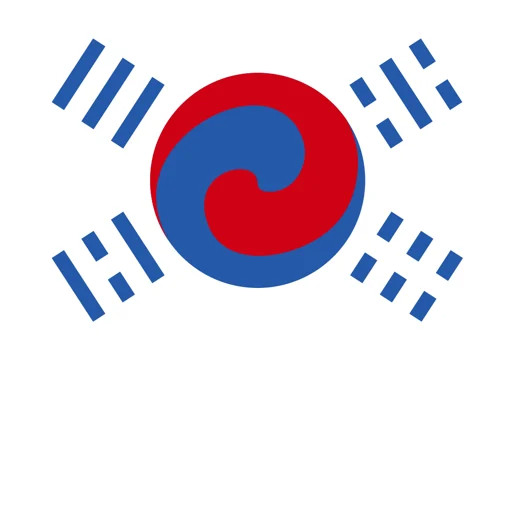
Denny Taegukgi
OriginThis is the oldest Korean national flag that still survives as a physical object. It was made in the late 1880s, only a few years after Joseon took the taegeuk as its flag, and King Gojong's court presented it to Owen N. Denny, the American who served as the king's adviser on foreign affairs. Denny carried it home when he left Korea in 1890; his descendants returned it in 1981, and it is now kept at the National Museum of Korea.
DescriptionA single circle sits on a plain white field, red above and blue below, but the two do not meet along the simple S-curve of today's flag. Each colour begins broad at the rim and winds almost a full turn inward, so the two arms coil around one another like a whirlpool: red is yang, blue is yin, the paired forces whose turning makes the world. Four blue trigrams stand on the diagonals: three unbroken bars at the upper left for geon, heaven; broken-solid-broken at the upper right for gam, water; solid-broken-solid at the lower left for ri, fire; and three broken bars at the lower right for gon, earth. The white ground has long been read as purity and peace.
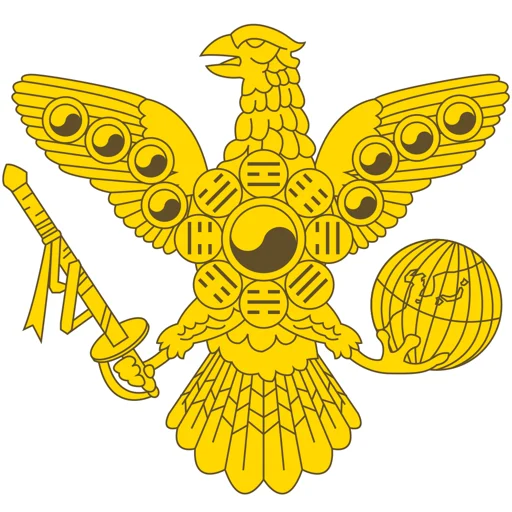
Eagle Emblem of the Korean Empire
OriginIn 1897 King Gojong renamed Joseon the Korean Empire and took the title of emperor. Wedged between Qing China, Japan and Russia, the young empire needed to show the outside world that it stood on its own, and it borrowed the visual language of European imperial arms to say so. The empire really did use this eagle — it was printed on the postage stamps issued in 1903 — and the drawing here is a modern redrawing of that emblem. The stamp was printed by the French government printing office, on the recommendation of a French postal adviser then serving in Korea. What the eagle with its sword and globe was modelled on has not yet been confirmed.
DescriptionA single-headed eagle, drawn entirely in gold with dark outlines, spreads both wings and turns its open beak to the viewer's left. On its breast sits a taegeuk, two interlocking halves in gold and dark brown, ringed by the eight trigrams: unbroken and broken bars in eight different arrangements, standing for heaven and earth, water and fire, thunder and wind, mountain and lake. Four more small taegeuk roundels are set into the feathers of each wing, filling the places where a European coat of arms would carry the shields of its provinces. The talon on the viewer's left grips a sword with a tasselled knot, raised at a slant away from the body, while the other cradles a globe engraved with the Korean Peninsula and the islands beside it — strength enough to defend itself, and a place among the nations of the world.
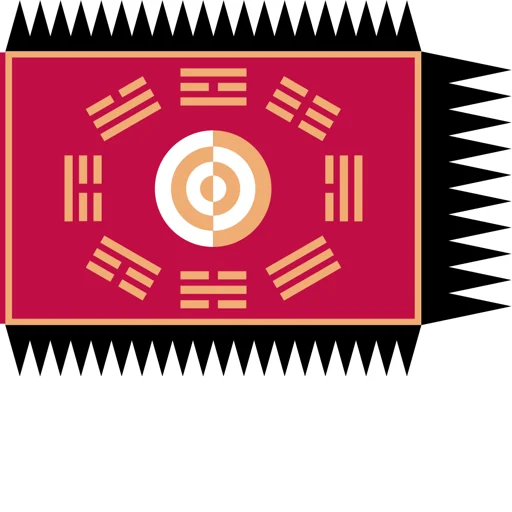
Royal Banner of the King of Joseon
OriginIn Korea this taegeuk-and-eight-trigrams design is conventionally known as the eogi, the king's banner — the flag said to stand for the king of Joseon himself. That attribution, and the provenance of the drawing it is taken from, have not been confirmed from institutional records. Neither has any direct line to the Korean national flag of 1882; no accurate record survives of the exact form of the flag flown that year.
DescriptionA deep crimson field is framed by an apricot border, and the three edges away from the staff are fringed with black flame-shaped teeth. At the centre a taegeuk is drawn as concentric rings, each ring split down the middle so that white and apricot swap sides from one ring to the next, yin and yang locked into each other. Eight trigrams surround it: at the top, solid–broken–solid is Ri, fire, and directly opposite at the bottom is Gam, water. Upper right, three broken lines make Gon, the earth; lower right, three unbroken lines make Geon, the heavens.


State & regional flags (17)
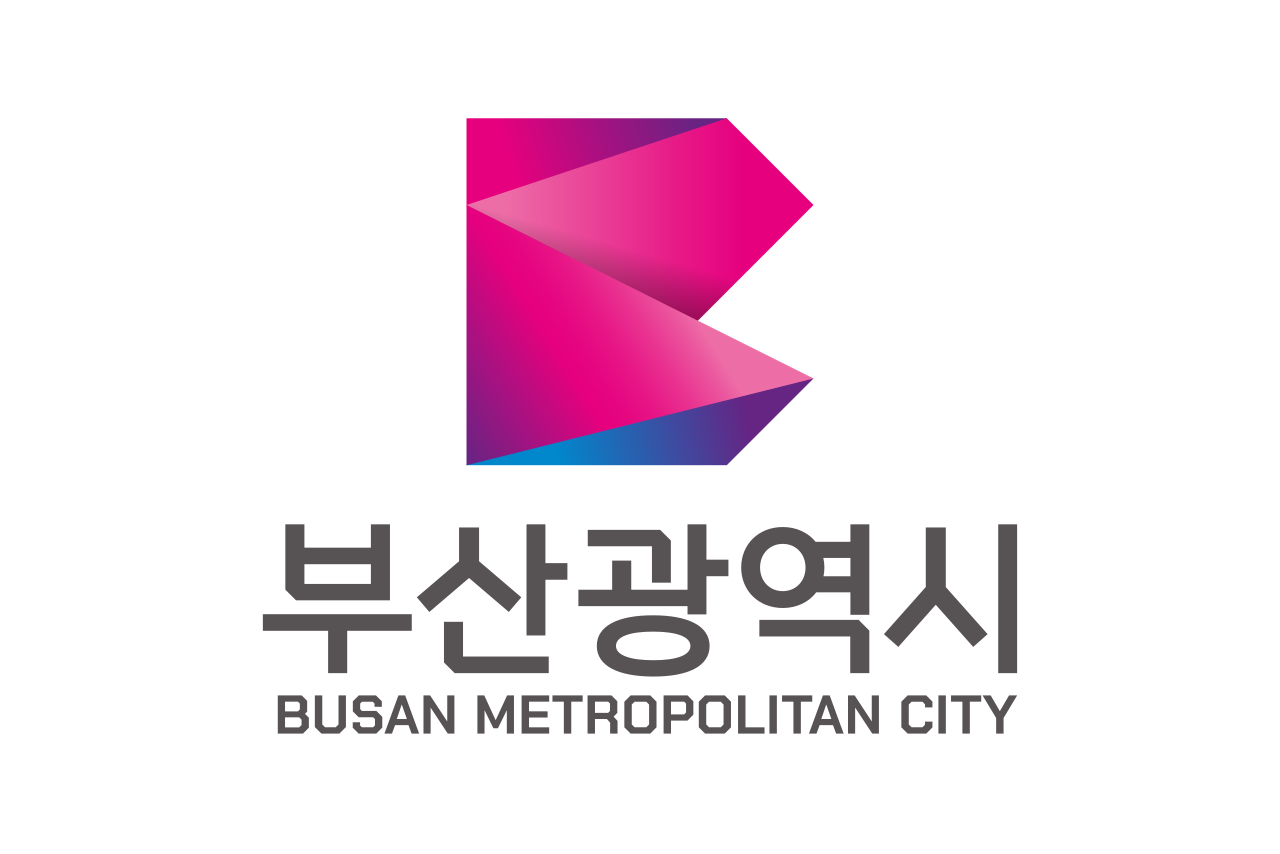
Busan
The letters B and S overlap to form the waves of Busan's sea and a three-dimensional cityscape. Magenta stands for the openness and passion of its people, cyan for a maritime city's technology and future.
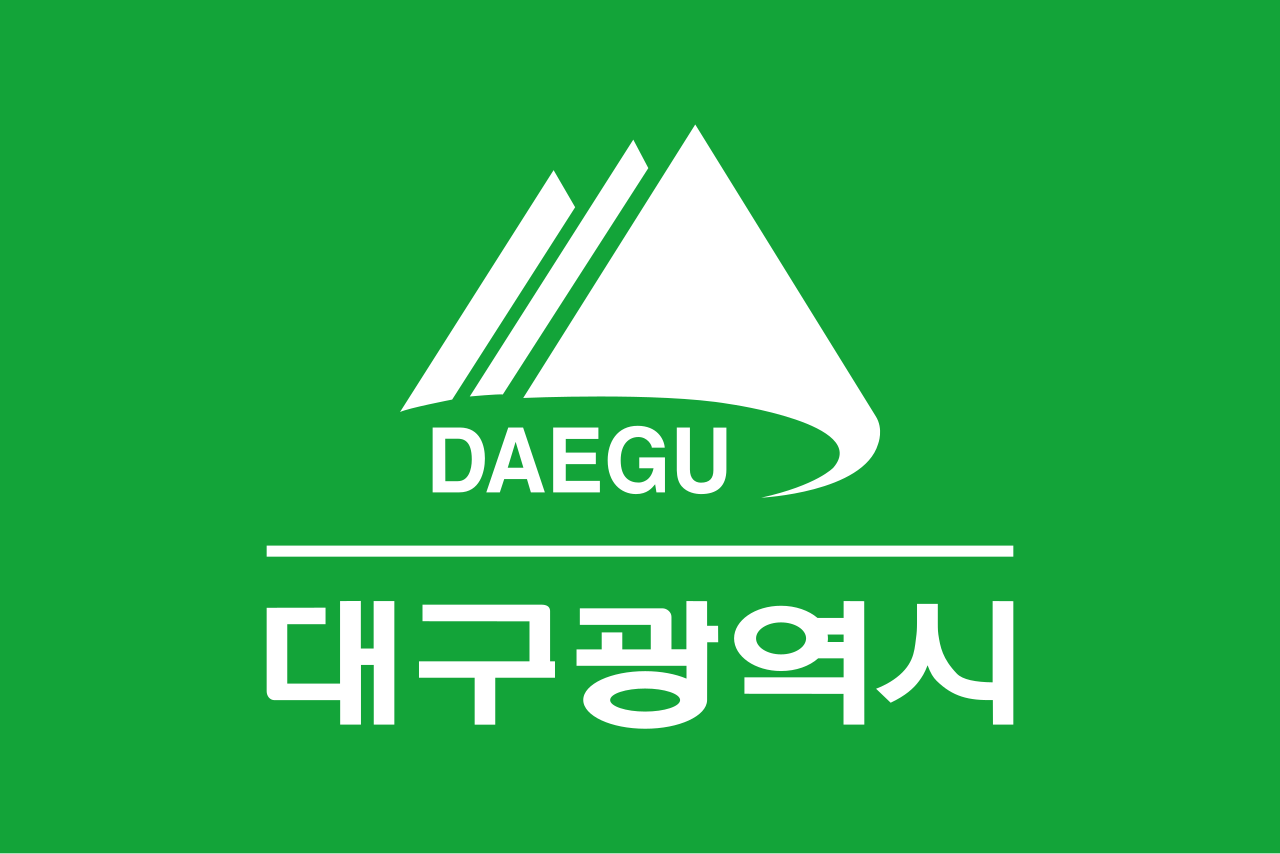
Daegu
White lines trace the ridge of Mount Palgong and the current of the Geumho River across a green field, with 'DAEGU' beneath. Green and white signal clean nature and the vitality of an eco-minded high-tech city.
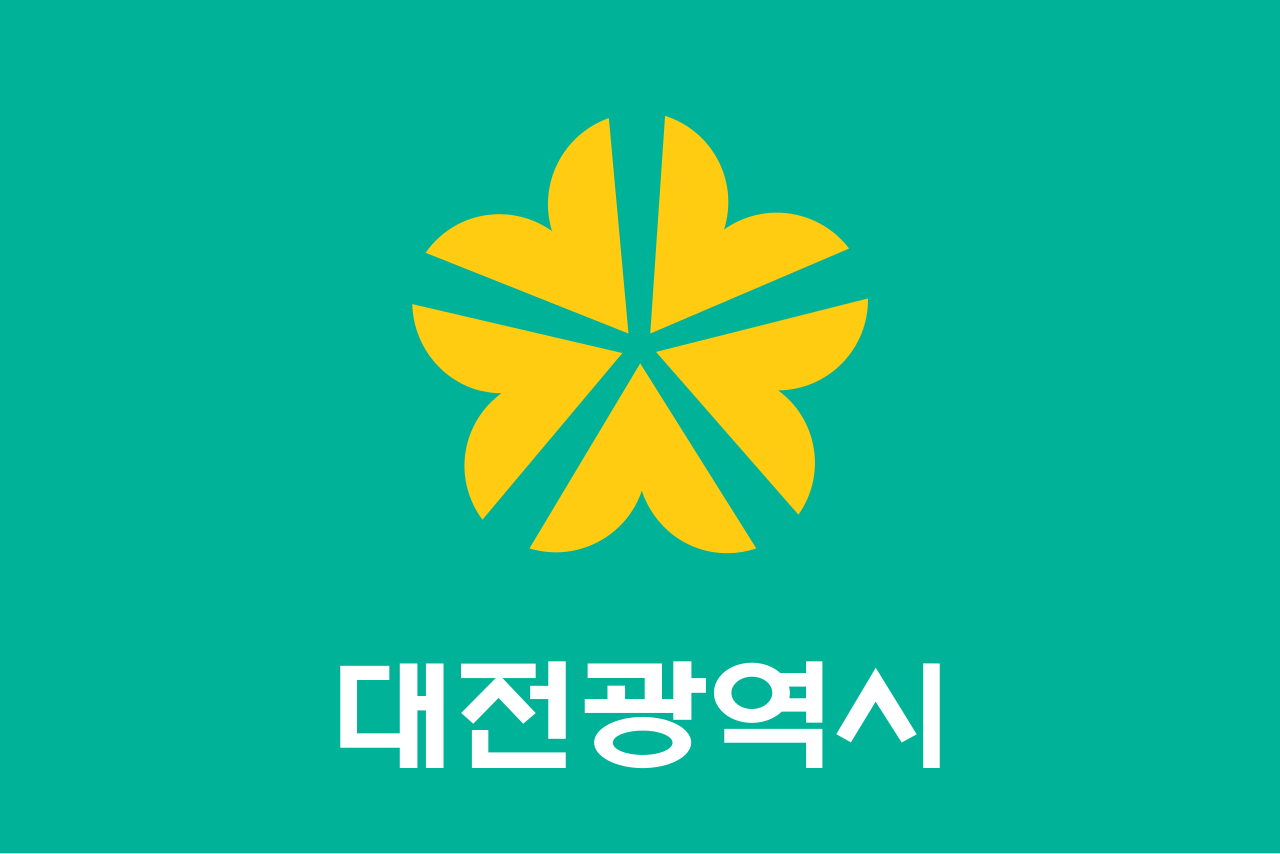
Daejeon
Yellow petals radiate across a teal field, carrying the outward energy of a city of science. Yellow is advanced science, teal the green, liveable surroundings.

Gangwon
Marking the launch of the special self-governing province, the Hangul word 'Gangwon' stands tall, its red strokes giving it a soaring lift. Red is passion and momentum; the remaining strokes are held in quiet grey so the red carries.
Gwangju
True to its name — 'city of light' — light spreads from the centre behind a figure with open arms. Red and orange stand for the passion of its citizens and the warmth of a city of the arts.
Gyeonggi
The initial consonants of 'Gyeonggi-do' — giyeok, giyeok, digeut — are redrawn as horizontal bars, for balance at the centre of the peninsula. Blue and green stand for peace and coexistence, resident-centred growth and a clean environment.

Incheon
A gateway city between sky and sea: a rising wing and an ocean wave curl into a single spiral. 'Incheon Blue' stands for trust as a Northeast Asian hub, the sea, and open possibility.
Jeju
Beneath the word 'Jeju', the ridge of Mount Halla and clear seas layer up. Blue is Jeju's sea, green Mount Halla and its ecology, orange the island's tangerines and the warmth of its people.
North Chungcheong
A blossom opening at the country's centre and a bird taking flight are layered into the strokes of 'Chungbuk'. Purple stands for high-value bio and new industries, blue and green for its rise as a central hub.
North Gyeongsang
Inside a blue diamond, white lines curve as the Baekdudaegan range, the Nakdong River and the East Sea. Blue is the sea, knowledge and the future; the flowing lines are tradition and the future side by side.

North Jeolla
Ribbons of wave and rising wing express 'a thousand years, taking flight'. Red, yellow, green and blue stand for life industries and tradition, golden fields, and a Northeast Asian economic hub.

Sejong
The Hangul consonant siot, the sweep of King Sejong's robe and the roofline of the Government Complex overlap to mark the administrative capital. The blues stand for balanced national development and a bright future.
Seoul
A brush-stroke rendering of the Hangul word 'Seoul' that also reads as a mountain, the sun, the Han River and a dancing figure. Green is the mountains and nature, blue the Han River and the city's energy, and the red disc the sun and hope for the future.
South Chungcheong
Round fruits in many colours gather like a single tree, holding the 15 cities and counties and their people together. The mix of colours stands for different cultures bearing fruit in harmony.
South Gyeongsang
Within a circle a red sun rises where green mountains meet a blue sea. Orange and red are passion and the sun, green the abundant land, blue the South Sea and advanced industry.
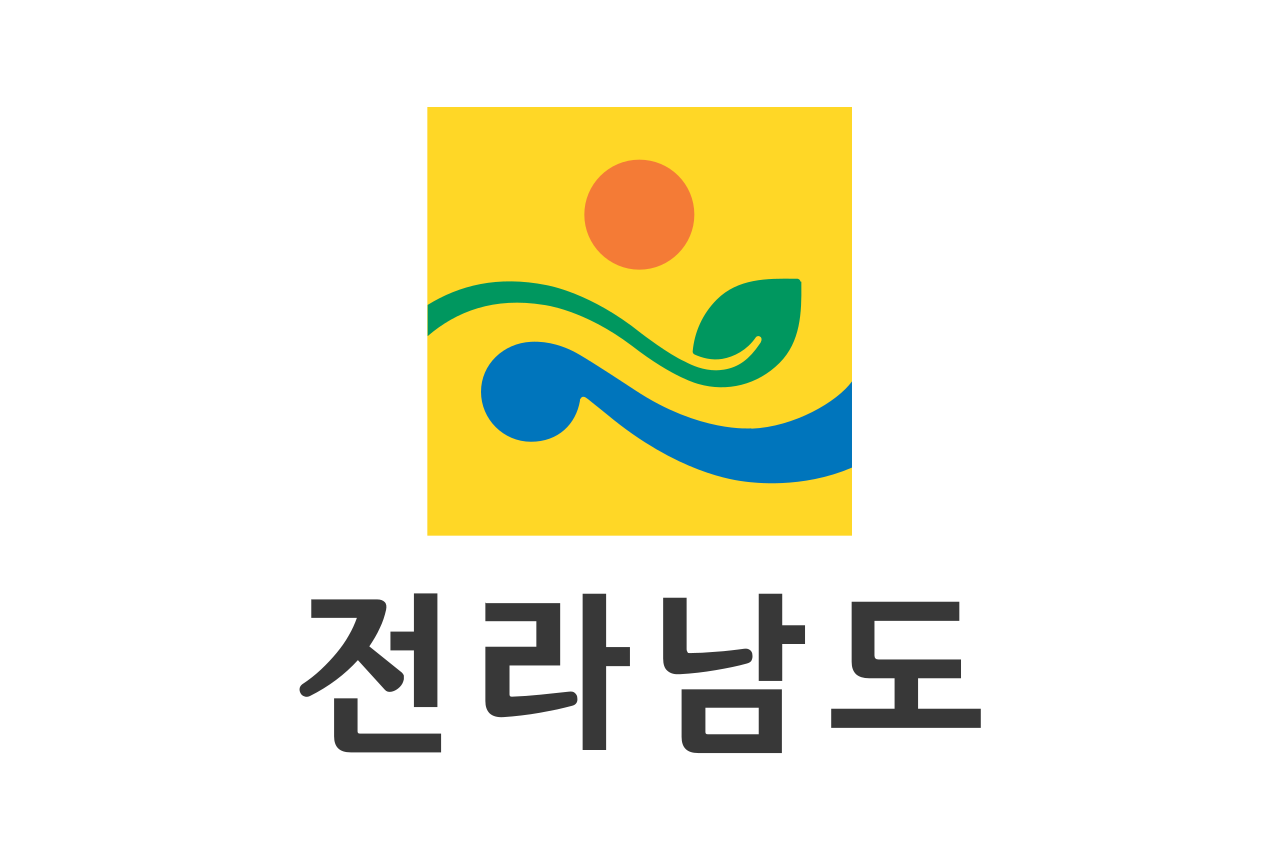
South Jeolla
An orange sun sits high at the centre of a yellow field, and below it a green curve ending in a leaf shape runs alongside a blue wave. The sun is hope, the green leaf clean nature and eco-friendly farming, the blue the South Sea.
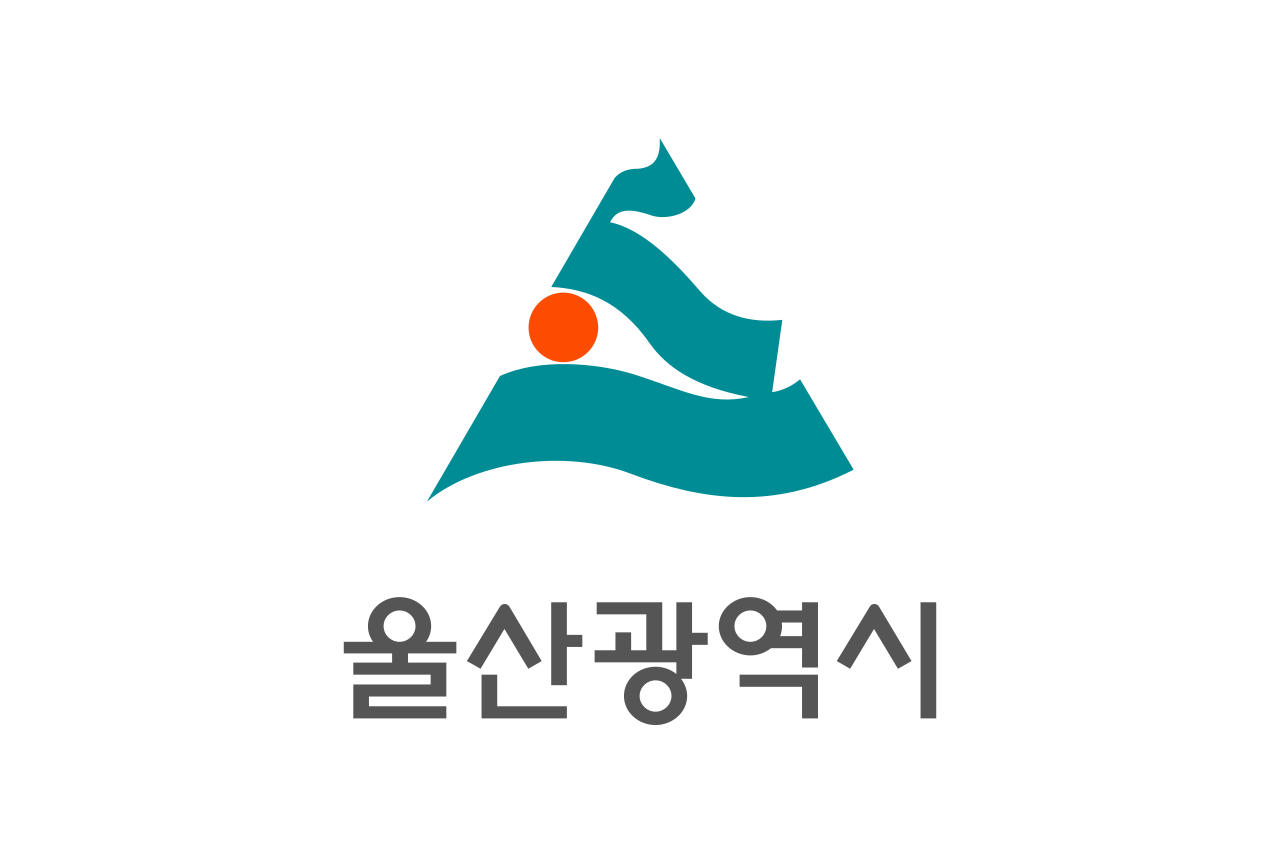
Ulsan
Curves join the waves of the East Sea to the ridgelines of the Yeongnam Alps, with a red sun above. Blue is the sea and the drive of Korea's industrial capital, green its eco-friendly side.
Data Sources
- What the flag means: 대한민국국기법(법률 제8272호, 2007. 1. 26. 제정) 제4조·제7조 및 같은 법 시행령
- Population: Population, total (SP.POP.TOTL), latest available value
- Area: World countries in JSON, CSV, XML and YAML
- Organizations: Membership of Principal UN Organs
- Organizations: Members and partners