Japan's Flag Became Law Only in 1999
A red disc on a white field. Japan's flag is one of the simplest designs in the world, and it has been in use since the mid-19th century. Yet Japanese law didn't name it the national flag until 1999.
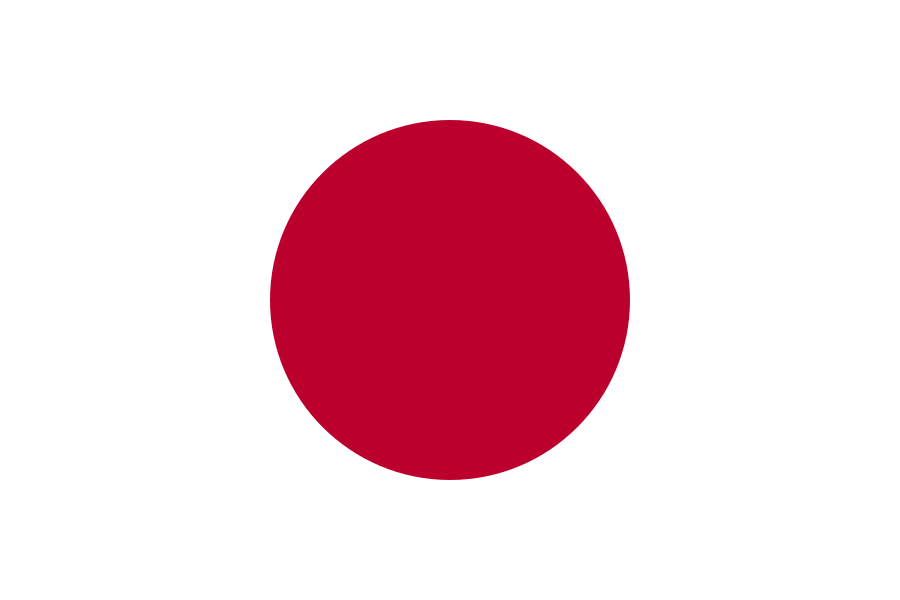
The 1870 rule was about ships
The usual starting point is Dajokan Proclamation No. 57, the Merchant Ship Regulations of the 27th day of the first month of Meiji 3, in the old calendar (1870). It told ships to raise the flag at 8 a.m. and lower it at sunset, and it set three sizes.[1]
Work out those sizes and each is 7:10, with a disc three-fifths of the height.[1] The disc was not centered. It was shifted toward the pole by one-hundredth of the length.[2]
The rule's text does use the word 御国旗, "national flag", but the navy and army rules of 1870 used it for their own flags too. It is hard to call this Japan's first flag law, because it dealt with ships. According to the historian of education Ono Masaaki, the shogunate had already adopted the sun flag in 1854 to mark Japanese ships. In 1870 the navy set a flag of its own at 2:3, height to width, by Proclamation No. 651, and the army had its own under No. 377. Three forms coexisted, and the confusion lasted until January 1940, when the Education Ministry adopted the merchant form.[2]
What 1999 settled
The bill passed the House of Representatives on 22 July 1999 and the House of Councillors on 9 August, and it was promulgated on 13 August as Act No. 127.[3] Article 1 says simply that the national flag is the sun flag.[4]
The design sits in an annex. Height is two-thirds of the width, the disc's diameter is three-fifths of the height, and the disc's center is the center of the flag. The field is white and the disc crimson, with no numeric color value.[4][5]
| Item | 1870 shipping rule | 1999 Act |
|---|---|---|
| Height to width | 7:10 | 2:3 |
| Disc diameter | 3/5 of height | 3/5 of height |
| Disc position | Shifted 1/100 toward the pole | Dead center |
The disc kept its size, and only the proportions and position changed. The Act's supplementary provisions repealed the shipping rule but said that for the time being the 7:10 ratio and the 1/100 shift could still be used.[4] That looks like a transitional rule for flags already made.
Why the law came so late
Answering a question in the Diet, the government said the flag had become firmly established among the public through long custom, and that the law gave that custom a statutory basis. It added that the law did not oblige anyone to display the flag.[6]
So the flag stood on custom for over a century. A national flag doesn't have to begin with a law, and sometimes the law arrives long afterward. That is why our country pages show each flag's legal basis separately. The methodology page explains how.
Sources
Read next
- Who Made the First Taegukgi?
From the 1882 treaty with the United States to the 1949 standard: what the records say about the origin of South Korea's flag, and what is still unresolved.
- Flag Proportions: What the Law Says and What It Doesn't
From Switzerland's square to Belgium's 13:15, we looked for famous flag proportions in the legal texts. Some numbers are there. Others aren't.
This page was drafted with AI (Claude). Its facts were checked against the sources listed below, and the site owner read it before publication. Found a mistake? Please write to us and include a source: Contact