Nepal's Constitution Tells You How to Draw Its Flag
Most of the constitutions we read describe their flag in a sentence or two. Nepal's goes further. Its schedule gives a step-by-step construction you could follow with a ruler and compass.
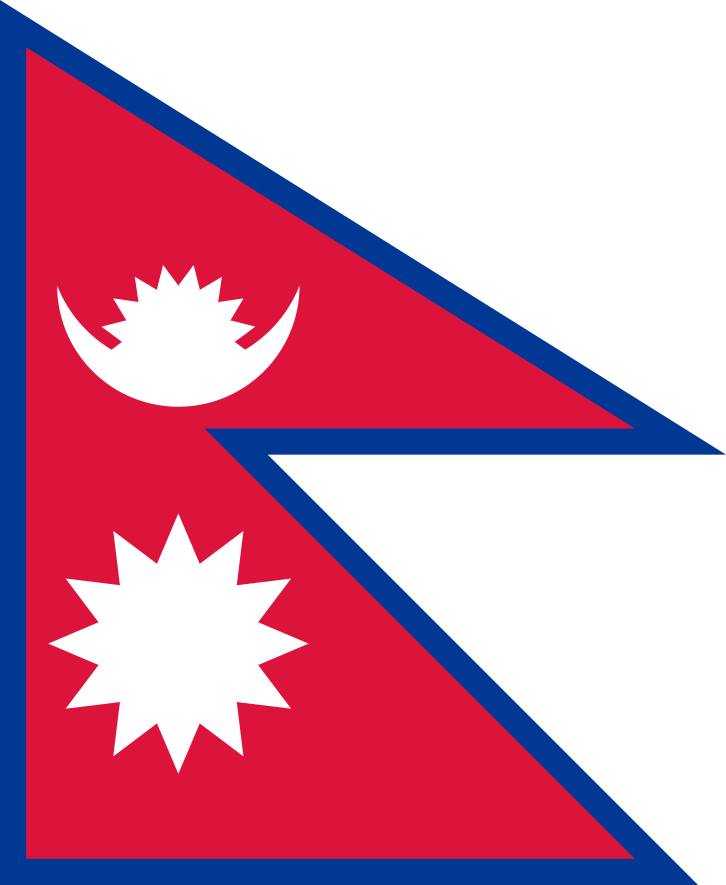
Article 8 and Schedule 1
Article 8(1) describes the flag as two joined triangles, crimson with deep blue borders. In the upper part is a white moon showing eight of its sixteen rays, and in the lower part a white sun with twelve rays.[1]
Article 8(2) leaves the method to Schedule 1, which has four parts: the shape inside the border, the moon, the sun and the border. There are 24 numbered steps in all.[1]
It starts with one line
The construction begins by drawing a line AB along the lower part of a crimson cloth. The next step sets the side AC equal to AB plus a third of AB.[1] By our arithmetic, that makes the inner shape four-thirds as tall as its base. The text doesn't state a ratio itself.
From there, points and lines are joined one after another to fix the edges of the triangles and the places of the moon and sun. A few of the steps give the flavor.[1]
- Step 18: the moon's eight triangles are to be equal and similar.
- Step 22: so are the sun's twelve.
- Step 23: the border is deep blue, and as wide as a length TN found during construction.
- Step 24: for a pole, the hole on the border along side AC can be extended as needed.
The construction lines don't appear on the finished flag. Actual size is left to the government.[1]
How old is this wording?
The current text is in the constitution gazetted on 20 September 2015.[1] The 1990 constitution used nearly the same words, called the design one handed down by tradition, and pointed to its own Schedule 1.[2]
Before that, things get less clear. The geometric rules are commonly traced to the constitution of December 1962, but sources give the 12th or the 16th, among others.[3] We did not read the 1962 text for this article.
On who drew up the construction, a 2019 report in the Nepali outlet Ratopati draws on the engineer Shankar Nath Rimal. It says Nepal had no fixed standard before 2019 in the Nepali calendar, about 1962, that differing flags abroad caused confusion, and that King Mahendra gave him the job.[4] That is one source resting on his own account, so it can't be treated as settled.
The origin of the two triangles is also a matter of tradition. One account has them as pennants of two rival branches of the Rana family, and there are others, but we found no firm record.[3]
Really the only non-rectangular flag?
Nepal's flag is often called the world's only non-rectangular national flag.[3] Strictly, that needs a condition: it can hold only if you mean a country's main flag.
Denmark shows why. The swallow-tailed flag carried by its royal house, parliament and state bodies is described in the remarks on its 2024 flag bill as not rectangular, and in that context it also counts as a national flag of the Realm.[5] Swissinfo reported in 2018 that Nepal was the one exception to the common rectangular format at the Olympics.[6]
We didn't find the "only" claim in any statute or official international document, so we pass it on here only as something commonly said.
Sources
Read next
- Flag Proportions: What the Law Says and What It Doesn't
From Switzerland's square to Belgium's 13:15, we looked for famous flag proportions in the legal texts. Some numbers are there. Others aren't.
This page was drafted with AI (Claude). Its facts were checked against the sources listed below, and the site owner read it before publication. Found a mistake? Please write to us and include a source: Contact