The Miranda Tricolor: What the 1806 Record Doesn't Say
The flags of Colombia, Ecuador and Venezuela all run yellow, blue and red. Their root is usually said to be the flag the independence leader Francisco de Miranda first raised in 1806. Yet a book by a man who sailed on that expedition never names its colors.
An eyewitness account
James Biggs, an officer aboard Miranda's ship the Leander, published his account in 1808. He says the "Columbian colours" were displayed for the first time at Jacmel in Haiti on 12 March 1806, marked by a gun and toasts.[1]
Here is how he describes it: an ensign formed of the three primary colors that predominate in the rainbow.[1] He doesn't name them. Across the whole book, "yellow" appears only three times, each time for uniforms, and the words yellow, blue and red never describe the flag. That the 1806 flag was yellow, blue and red comes from later writers, not from this eyewitness.
The later mentions are brief too. Biggs says the Columbian colors replaced the Spanish standard on the staff at La Vela de Coro.[1] Miranda's proclamation ordered the ensign on churches and cockades in hats.[1] Later the ship flew Columbian, American and British flags at different times.[1] What is now commemorated as a founding flag wasn't yet a fixed symbol.
Researchers even disagree on whether the Leander's flag was a tricolor at all. Some describe a separate command standard, with a sun and moon on a blue field.[2]
Why those colors is less certain still. Goethe's color theory, the Hamburg citizens' guard and a fresco in Genoa have all been proposed, and none is confirmed. All Biggs supports is the phrase about the rainbow's primaries.
The three countries today
Venezuela's law, at least, says less about Miranda than you might expect. Article 3 says only that the flag is inspired by the one Congress adopted in 1811, and doesn't name him.[3]
| Country | Stripes | Emblem | Basis |
|---|---|---|---|
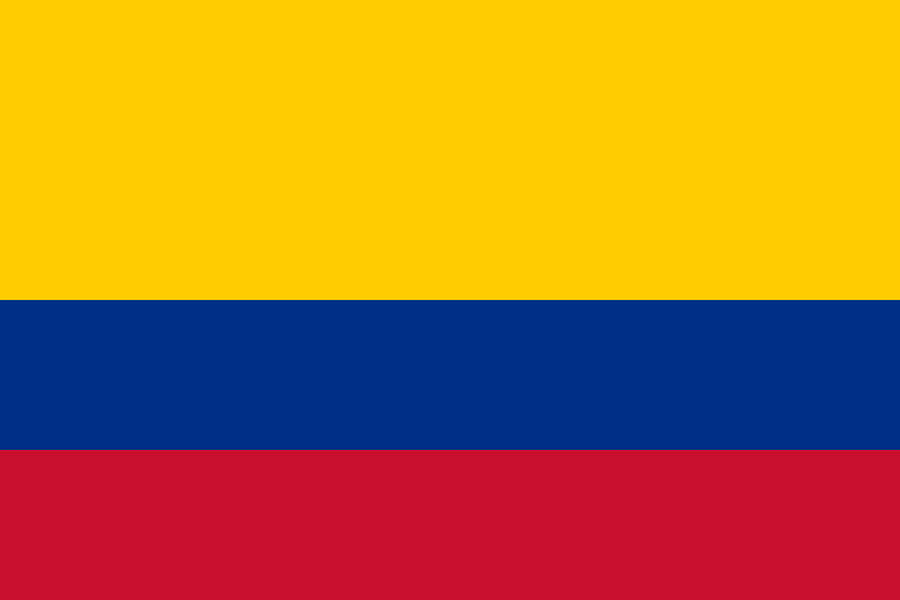
| Colombia | Yellow fills the top half | None | Decree of 26 Nov 1861[4] |
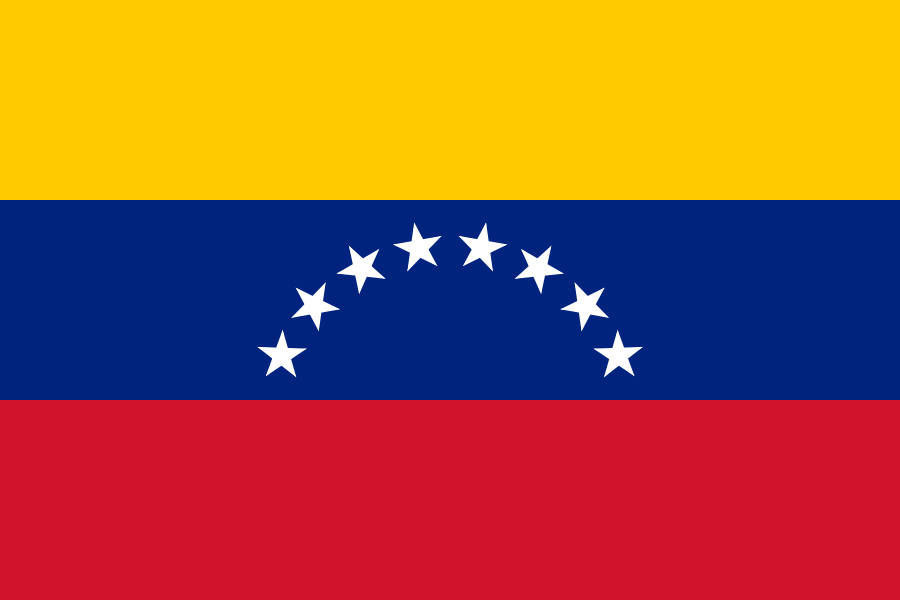
| Venezuela | Three equal stripes | Arc of 8 white stars on blue | 2006 law[3] |
| Ecuador | Yellow reported as wider[5] | Arms reported on the state flag[5] | Colors: decree of 26 Sept 1860[6] |
Colombia's 1861 decree gives yellow the top half of the flag, and sets the war flag at 72 centimeters of yellow to 36 of blue.[4] Ecuador set yellow, blue and red by García Moreno's decree of 1860, and according to El Universo a legislative decree of 1900 kept it and made 26 September Flag Day.[6] Another report dates that choice to 1955.[7]
The politics of one star
Venezuela's eighth star is an old story. Simón Bolívar ordered it by decree in 1817.[8] Sources date the decree to 15 October or 20 November. The order was not followed for long.[9] In March 2006 the National Assembly brought it back, and President Hugo Chávez launched the new flag on 12 March, the 200th anniversary of the 1806 flag.[10]
The opposition didn't recognize the change,[8] and in 2024 parts of it were still using seven stars.[11] Nicolás Maduro floated a ninth star in 2021, which had not been approved as of January 2026.[9]
Sources
- The History of Don Francisco de Miranda's Attempt to Effect a Revolution in South America (James Biggs, 1808)
- Venezuela: historical flags
- Ley de Bandera Nacional, Himno Nacional y Escudo de Armas de la República Bolivariana de Venezuela
- Decreto del 26 de noviembre de 1861
- Ecuador
- Día de la Bandera: desde cuándo se celebra en Ecuador
- Día de la Bandera Nacional: ¿por qué se celebra el 26 de septiembre y qué significan sus colores?
- Bandera de Venezuela: 17 años desde la inclusión de la octava estrella
- ¿Por qué Venezuela tiene ocho estrellas en su bandera?
- Chavez flies the flag for change
- Bandeira da Venezuela, nova desculpa do chavismo para perseguir
Read next
- Telling Look-Alike Flags Apart
How to tell apart twelve groups of confusable flags, from Nordic crosses and Pan-Arab colors to vertical tricolors, one difference at a time.
- Some Countries That Have Changed Their Flags Since 2000
Georgia, Iraq, Myanmar, Libya, Mauritania, Kyrgyzstan and Syria: dates, procedures and new designs for flags revised since 2000, from laws and reports.
This page was drafted with AI (Claude). Its facts were checked against the sources listed below, and the site owner read it before publication. Found a mistake? Please write to us and include a source: Contact